Gemini 4 Argon: What It Is, Who Can Use It, and What It Means If You Build Software
Google announced Gemini 4 Argon on September 30, 2026. Learn what is confirmed, who can access it, and how to prepare your product while the rollout is restricted.
Google announced Gemini 4 Argon on September 30, 2026, and called it its most powerful model yet. There is a catch: you probably can't use it today. Here is what is confirmed, what is not, and what to do while you wait.
What Gemini 4 Argon is
Argon is Google's new frontier model. Google says it is built for long, complex jobs that need sustained reasoning, and it points to three areas: real-world software engineering, enterprise knowledge work such as legal and finance, and cybersecurity defense.
Details from Google's announcement:
- Output limit of 1 million tokens, up from 64,000. A single answer can now run to hundreds of thousands of tokens.
- Introductory pricing: $2 per million input tokens and $10 per million output tokens. Cached input tokens cost 95% less than normal input. After the introductory period, Google says the price becomes $4 per million input and $20 per million output.
- Strong on images and video. TechCrunch notes it can analyze long videos and charts.
- Safety work. Google says it is more resistant to prompt injection and monitors the model's reasoning and actions, stopping execution when needed.
Who can use it today
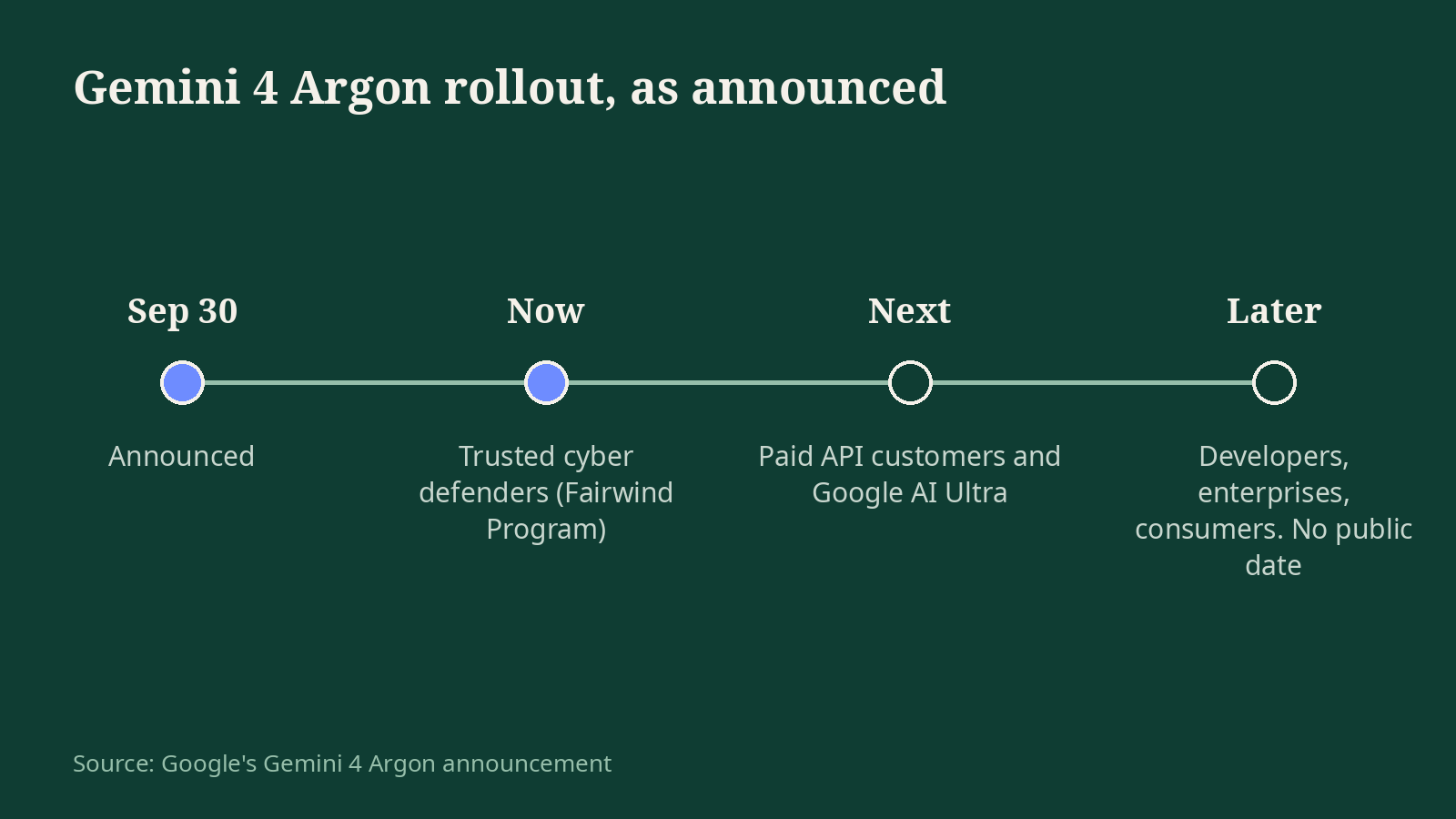
Almost nobody. Argon is rolling out first to a set of trusted cyber defenders through Google's Fairwind Program. Google says it will then reach developers, enterprises and consumers "as soon as possible", starting with paid API customers and Google AI Ultra subscribers. It says it is also taking part in the US government's voluntary pre-release access process. There is no public date.
So any post that tells you to "use Argon today" is guessing. Here is what you can do now.
How to prepare
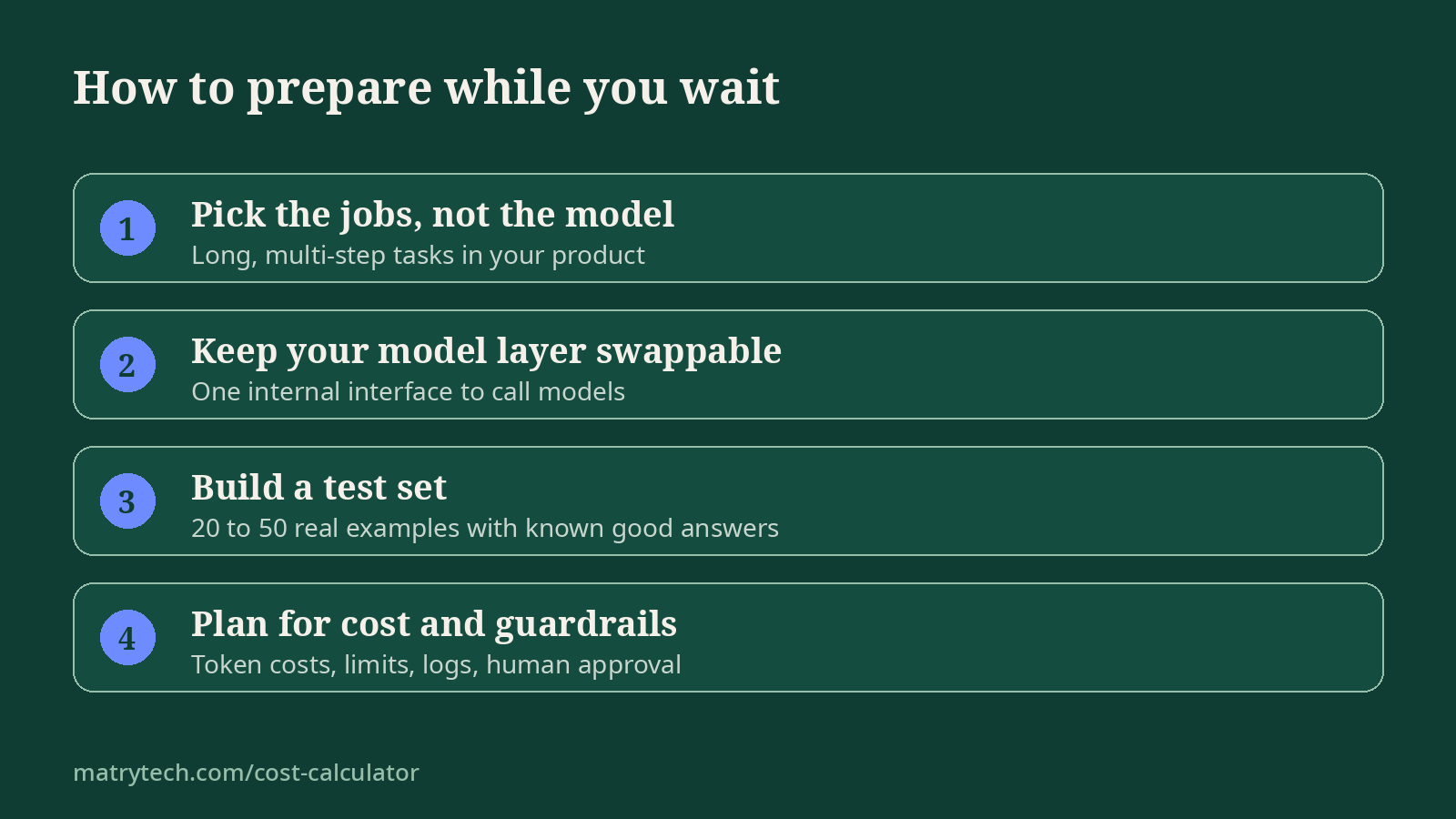
- Pick the jobs, not the model. List the long, multi-step tasks in your product or team: code migration, contract review, financial analysis, research summaries.
- Keep your model layer swappable. Call models through one internal interface, so switching to Argon or any other model later is a config change, not a rewrite.
- Build a test set now. Collect 20 to 50 real examples with known good answers. When access opens, you can compare models in an afternoon.
- Plan for cost. At $2 and $10 per million tokens (rising to $4 and $20 after the introductory period), long outputs add up. Caching helps with repeated context.
- Plan for guardrails. Google's own launch stresses prompt-injection defense and monitoring. Any agent you build that can act for a user needs the same: limits, logs and human approval for risky steps.
Best use cases, based on what Google says it is good at
- Large code migrations and optimization. Google describes Argon agents moving C/C++ code to Rust at scale, with heavy auditing before anything ships.
- Deep research and writing. Long reports, with room for the model to think before answering.
- Enterprise knowledge work. Legal and finance workflows are named in the announcement.
- Security work. Finding, validating and patching vulnerabilities, for approved defenders.
What it means if you are building a product
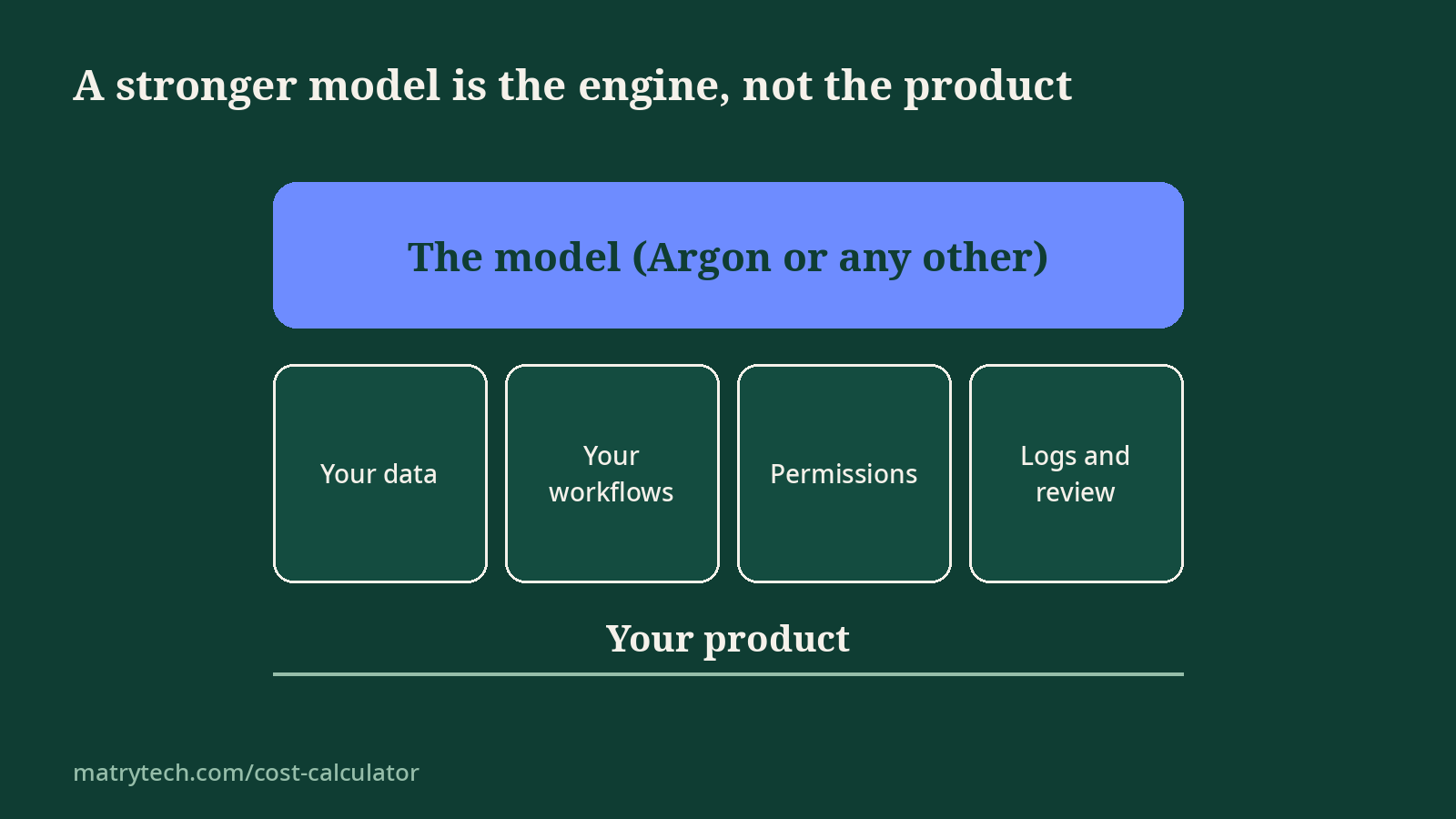
A stronger model does not give you a product. It gives your product a better engine. You still need your own data, your own workflows, permissions, logging and a way to check the output.
Teams that win with new models do three things: they keep model choice flexible, they test on their own data, and they put humans in the loop where a mistake is expensive.
If you are planning an AI agent for your product, we can scope it with you. Use our cost calculator for an indicative range, or book a 30-minute discovery call.
Sources: Google's Gemini 4 Argon announcement (blog.google), TechCrunch (September 30, 2026), The Verge (September 30, 2026).