AI chatbot vs live chat for a US service business: what to automate before you build
Form, live chat, packaged chatbot or custom integration? A US service-business buyer guide to enquiry handoffs, CRM gaps and acceptance tests.
A visitor asks whether you can handle their project. Your team is offline. By morning, you have a name, an email address and a vague request, but not enough to prepare a useful reply.
An AI chatbot is one possible fix. A better form, staffed live chat or a packaged helpdesk could be enough. Custom development needs a clearer reason: a tested gap in your qualification rules, CRM connection, booking process or approval steps.
Start with the smallest option that gets an accurate brief to a named person. If fixed questions do the job, improve the form. If the conversation needs judgment and you can cover the hours, consider staffed chat. Test packaged AI for repeat questions from approved material. Add engineering only when you can name and demonstrate what is missing.
This guide helps US service businesses choose a website enquiry workflow. Its examples are illustrative, not customer results. It does not cover clinical advice, lending decisions or other high-stakes automation. For the wider journey from first enquiry to delivery, see our solo-founder workflow guide. Here, the decision is narrower: what should happen between a visitor's question and a conversation your team can act on?
Define the handoff before choosing the channel
Write down what your team needs for a useful response. For project-based work, that could be:
- The visitor's need, in their own words.
- Service interest, location and relevant time zone.
- Preferred contact method and contact details.
- Constraints that affect fit, such as an existing system or required connection.
- Open questions and anything a person must decide.
Ask for a budget range or target date only when it affects a real decision. Let visitors skip a question, correct an answer or request a person. A longer transcript is not a better handoff by itself.
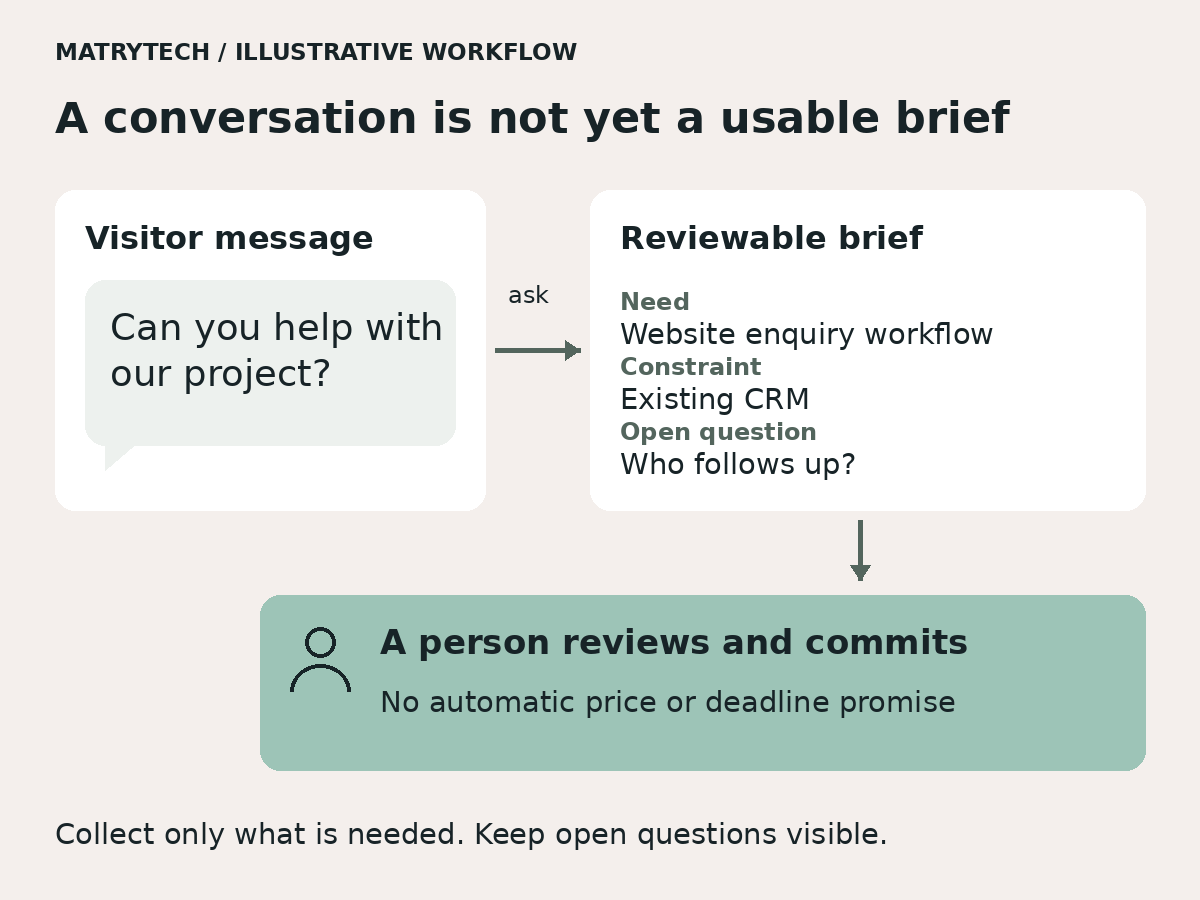
Illustrative workflow, not a customer result. The system prepares the brief; a person makes any unapproved commitment.
Give every enquiry a named owner and a follow-up window you can honestly state. Buying another channel does not fix an inbox that nobody owns.
Compare five routes
This is editorial buying guidance, not a validated diagnostic or a performance ranking.
| Route | Fits when | What to verify |
|---|---|---|
| Better form | The visitor can describe the need through predictable questions | Conditional fields, clear next step and a responsible person |
| Staffed live chat | The exchange needs judgment or careful explanation | Actual coverage hours, time zone and an out-of-hours fallback |
| Packaged AI chatbot | Repeat questions can be answered from approved information | Unknown-answer behavior, context-preserving handoff and operating terms |
| Packaged tool plus integration | The tool works except for a specific missing connection or rule | Record ownership, permissions, retries and failure recovery |
| Custom build | Important scenarios still fail after configuration and integration options are tested | Written acceptance tests, maintenance owner and bounded scope |
These routes can work together. A form can collect a project brief while a bot answers approved FAQs. People can take over the same conversation during staffed hours. Choose each part for a defined job, rather than forcing every visitor through one channel.
How to make the choice without skipping the test
First, check whether a form can collect the brief accurately. If it can, there is no need to add conversational AI merely to ask the same fixed questions.
If visitors need a conversation, separate judgment from repeat information. Negotiating scope, assessing an unusual requirement or agreeing a contract exception belongs with a person. If you cannot staff immediate replies, offer a callback or email route. Do not make a chat window look attended when it is not.
For repeat questions, trial a packaged tool against real, anonymized enquiries. A promising demo is the start of that test, not the end of the decision. If it passes your scenarios and its operating terms fit, keep it. If it fails, identify the failure before moving to engineering:
- Missing content or configuration? Correct it and retest.
- One missing connection or routing rule? Assess a bounded integration.
- Data boundaries, approvals or multi-system rules that remain unmet? Assess custom work against the same tests.
Do not stop at "a packaged chatbot sounds suitable." Continue until the actual tool passes, or you have a specific failed scenario to scope.
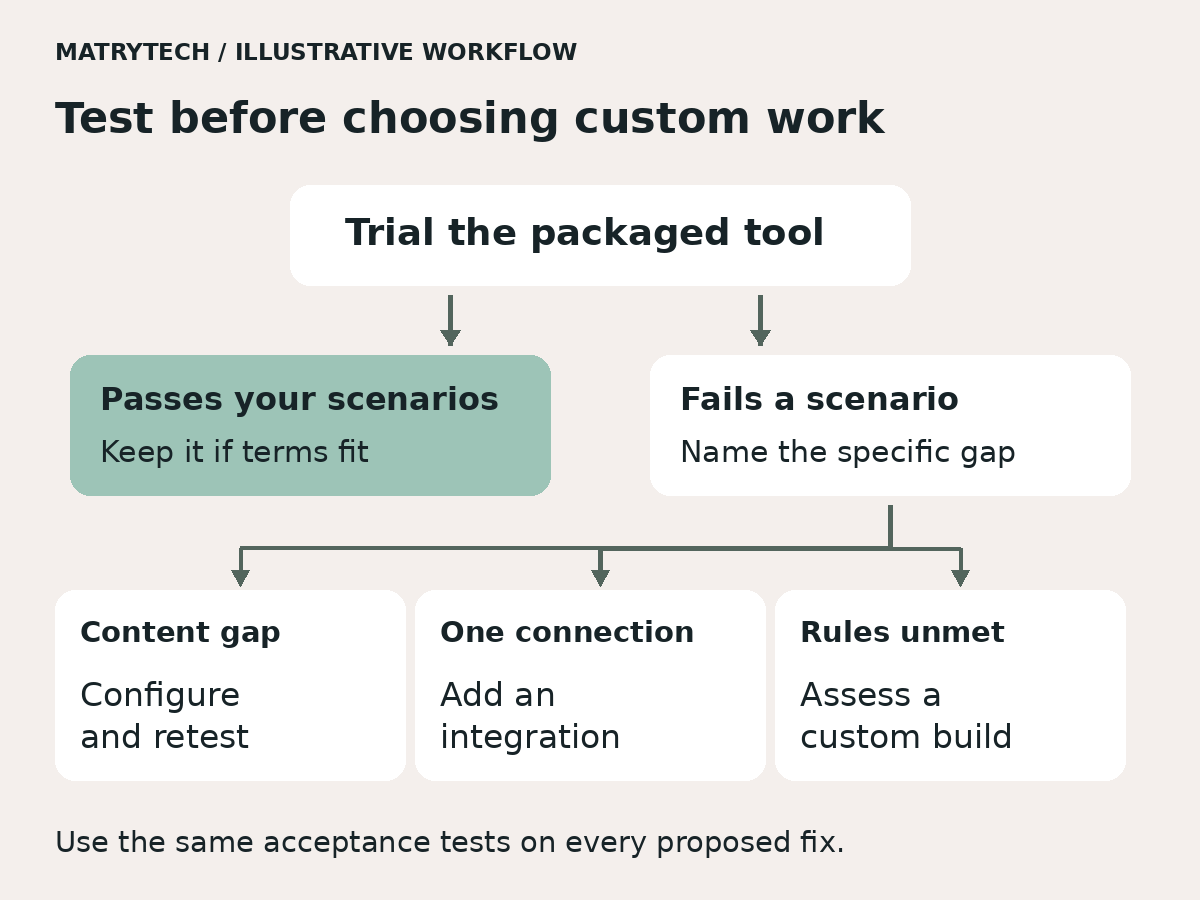
After the trial, keep a tool that passes. If it fails, identify whether the gap calls for configuration, one integration or custom work. Use the same tests again.
What to ask a packaged-tool vendor
Intercom's comparison of chatbots, live chat and AI agents is vendor guidance, not an independent ranking. Use it to frame questions about observable behavior, not to adopt its performance or pricing claims.
Ask a vendor to show:
- Where answers come from and what happens when approved material does not contain an answer.
- How a visitor reaches a person, with their context intact.
- Which CRM and booking connections are included, and which require extra work.
- How records can be exported, corrected and removed.
- How charges work across seats, usage, outcomes and integrations.
Compare the complete setup you would run. A bot and a helpdesk from different suppliers may require extra handoff work. Demonstrate that exact combination rather than assuming compatible product labels mean the history will transfer correctly.
For US visitors, show the actual staffed time zone. Check phone-number formats, daylight-saving changes in bookings and USD wherever an approved price is displayed. These are operating checks, not proof of legal compliance.
Where engineering earns its place
A useful engineering brief names an action and its boundaries. Examples include attaching an enquiry to the correct CRM opportunity, checking an authenticated customer's record, routing by service area or offering slots from a real calendar.
The hard part is what happens around the action. Who owns the record? What access does the assistant have? Does a retry create another lead? Can someone recover when the calendar is unavailable?
Keep the packaged interface if it passes your tests. Scope the missing connection before replacing the whole platform. If a vendor proposes a custom replacement, ask which scenarios configuration or an integration cannot satisfy.
Matrytech's AI agents and automation offer covers workflow integrations and bounded use cases. That is a reason to discuss a specific gap, not evidence that your business needs a custom agent.
Set authority, privacy and handoff limits
For an initial enquiry, the assistant may explain approved services, collect a brief and request a callback. Negotiated prices, guaranteed delivery dates, contract exceptions and other unapproved commitments stay with a person.
If booking is included, show confirmation only after the booking system confirms success. A callback request is not a confirmed appointment.
A handoff also needs a result, not only a button. Microsoft's bot-to-human handoff design illustrates sending context and a transcript and distinguishing an accepted handoff from a failed one. It is a design reference for an older SDK, not a recommendation to adopt that SDK.
Before a pilot:
- Tell visitors when they are interacting with an automated assistant.
- List the suppliers that receive conversation data, where it is processed, retention settings and available deletion controls.
- Avoid sensitive information that an initial enquiry does not need. Provide a separate secure route when later work requires it.
- Review any planned text-message follow-up separately from collecting a phone number.
- Have a qualified adviser check the requirements that apply to your business and the states you serve.
These are questions to resolve, not a US legal checklist. This guide does not certify compliance. NIST's AI Risk Management Framework is voluntary guidance; a vendor's claim of alignment is not evidence that its particular product passed your tests.
Ask for ten acceptance tests
Define the expected result before the demonstration. Use the same scenarios for a packaged tool, an integration proposal and a custom build.
| Scenario | A pass looks like |
|---|---|
| Ordinary enquiry | Accurate answer and a clear next step |
| Unknown requirement | Gap admitted and routed for review |
| Person requested | Useful context reaches the person without needless repetition |
| Nobody available | Honest fallback, with no invented response-time promise |
| Detail corrected | Final brief reflects the correction |
| Request repeated | Agreed duplicate handling prevents extra records or bookings |
| Connection fails | Failed action is not described as successful |
| Another customer's data requested | Access boundaries hold |
| Price or deadline guarantee demanded | No authority is invented |
| Record removal requested | Agreed deletion process can be demonstrated across relevant systems |
Record what passed, failed and remains out of scope. A polished happy-path demonstration is not enough. Keep real customer secrets out of sales demos and initial scoping enquiries.
Measure the handoff, not chat activity
Before making the change, establish a baseline for comparable traffic sources and time windows. Then track valid enquiries, usable briefs, completed follow-ups, qualified conversations and confirmed meetings or sales separately.
Also record wrong answers, failed handoffs, duplicates, staff review time and running costs. Exclude spam and internal tests from buyer counts. A submitted form is not automatically a qualified lead; a booked call is not a completed sale.
An automated reply can acknowledge a visitor outside office hours. Whether the workflow improves enquiry quality or business results is something the pilot must show. This article does not promise a conversion lift, delivery time or price.
Bring a workflow to the scoping conversation
Matrytech builds custom AI agents and connects business tools. Our public offer describes approval points and tests that include bad inputs and connection failures. The contact page says the first call covers build versus buy.
Bring three anonymized enquiry examples, your existing tools, the desired handoff and the actions a person must approve. If you have trialed a packaged tool, bring the scenarios it failed. That failure list is more useful than a request for "an AI chatbot."
Discuss your enquiry workflow with Matrytech. The next step is to understand the gap, not assume a full replacement build.
Sources and editorial scope
Reviewed 19 November 2026:
- Matrytech AI agents and automation and contact, for the published offer and build-versus-buy scoping context.
- Matrytech's solo-founder workflow guide, for the broader enquiry-to-delivery topic, distinct from this channel decision.
- Intercom's channel comparison, attributed vendor guidance; no vendor performance claims adopted.
- Microsoft's handoff design, for context transfer and handoff states, not a product recommendation.
- NIST AI Risk Management Framework, for voluntary risk-management guidance.
The comparison, test sequence, acceptance scenarios and measurement advice are editorial guidance, not research findings. No customer result, legal conclusion, search-ranking improvement or sales outcome is claimed.