How Much Does It Cost to Build a Custom AI Receptionist for Your Clinic? (2026)
What a clinic AI receptionist costs to build and run: SaaS seats vs custom build vs white-label on your own AWS. Market ranges, sources cited.
Short answer: a custom AI receptionist typically costs roughly $12,000–$80,000 to build (market range, not Matrytech pricing), based on Innovation Insight ($12k–$22k for a one-flow pilot, $22k–$45k for a production agent with calendar and CRM integrations) and RaftLabs ($15,000–$35,000 for a basic agent, $35,000–$80,000 for a production multi-intent agent). Running it adds roughly $0.05–$0.20 per call minute for telephony, speech and AI usage (market range, not Matrytech pricing; Innovation Insight), while renting an off-the-shelf SaaS receptionist starts at about $0–$449 a month on entry plans (market range, not Matrytech pricing; CallBotScore, October 2026). A third route is a white-label receptionist under your clinic's brand on your own AWS, paid as a setup fee plus a monthly retainer, with third-party usage billed at cost.
Prices checked: 19 October 2026. USD ranges; local pricing varies.
What you're actually paying for in a clinic AI receptionist
An AI receptionist is a chain of parts, and each part has a cost:
- The phone number and telephony. A local or toll-free number, inbound minutes, and the SMS confirmations that go out after a booking.
- Speech-to-text. Turning the caller's voice into text the system can work with.
- The language model. The part that understands what the caller wants and decides what to say next.
- Text-to-speech. The voice the caller hears.
- The booking logic. The rules for appointment types, durations, providers, buffers and reschedules.
- The practice-management integration. Reading availability and writing bookings into your PMS, such as Dentrix.
- Hosting and monitoring. The compute the whole pipeline runs on, plus the dashboards and alerts that tell you when something breaks.
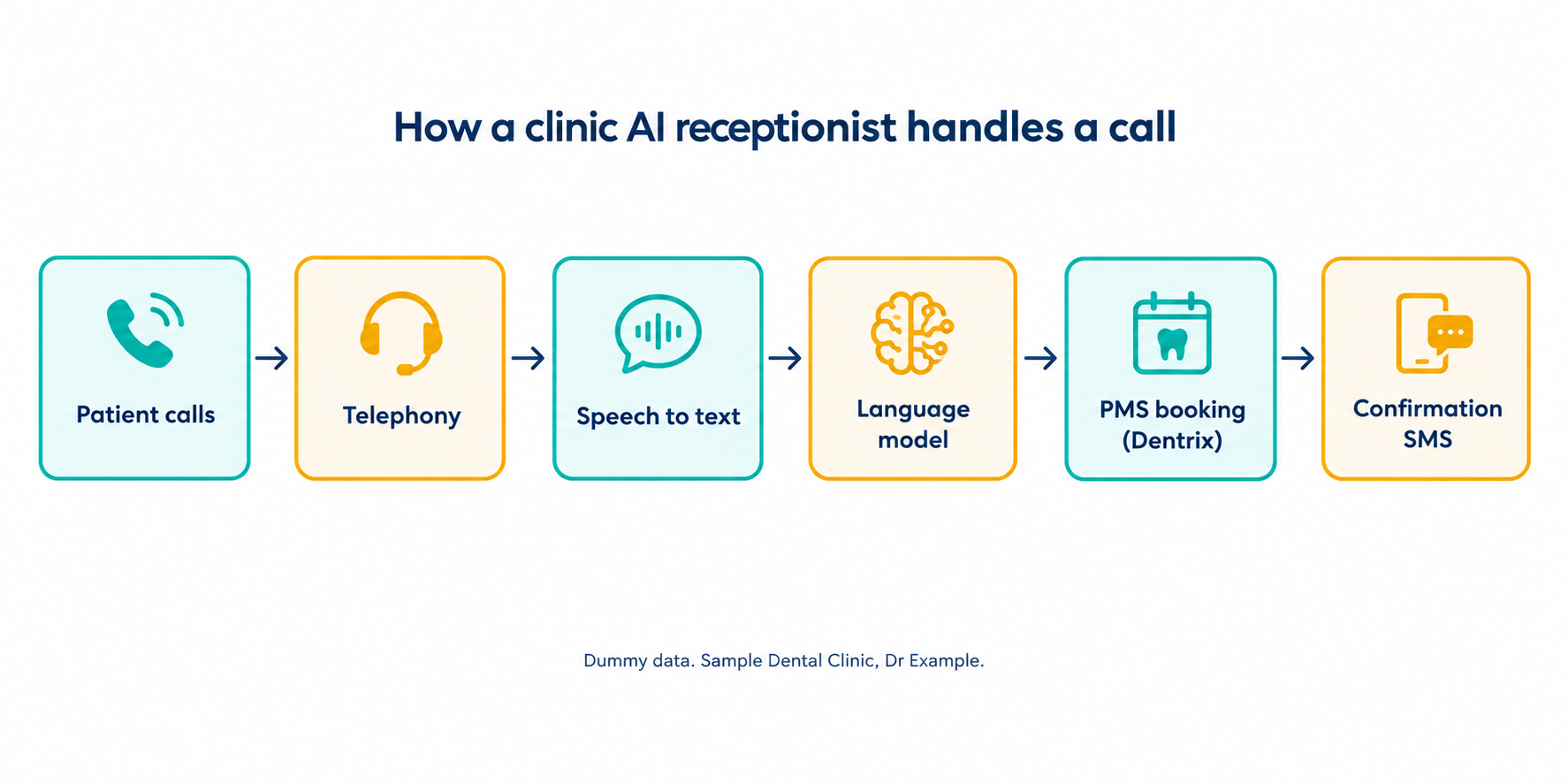
Alt: Call flow of a clinic AI receptionist, from the incoming call to a confirmed booking. Dummy data.
A useful market observation from RaftLabs' cost guide: integrations, not the AI model itself, typically drive 40–60% of the engineering work on a voice agent. That is why two quotes for "an AI receptionist" can be far apart. The demo voice is the cheap part. Making it book, reschedule and cancel correctly inside your practice-management system, at your call volume, is where the work is.
Three ways to get an AI receptionist (and what each costs)
Route A: Rent seats on a SaaS AI receptionist
You subscribe to an existing product. Pricing is usually monthly per location, billed per minute, per call or per caller. Published entry prices across 12 tracked vendors run from $0 to $449 a month (market range, not Matrytech pricing; CallBotScore, checked 16 October 2026). At 200 calls a month, the median across 20 priceable vendors is about $160 a month (market range, not Matrytech pricing; The Front Desk Review).
Pros: fast to start, cheap to try, no build project. Cons: it is the vendor's brand and the vendor's cloud. Entry plans often limit write-back into practice-management systems, per-minute costs climb as call volume grows, and your call recordings and patient data sit with the vendor.
Route B: Commission a fully custom build
An agency builds your receptionist from scratch around your workflows. Published build ranges: $12k–$22k for a pilot, $22k–$45k for production, $45k–$90k+ for enterprise (market range, not Matrytech pricing; Innovation Insight). RaftLabs lists $15,000–$35,000 for a basic agent, $35,000–$80,000 for a production multi-intent agent, and $80,000–$150,000+ for an enterprise platform (market range, not Matrytech pricing). Sheerbit lists $15K–$35K for a single-use-case agent and $50K–$80K for a multi-intent build (market range, not Matrytech pricing).
Pros: everything is bespoke, and you own the system. Cons: the highest upfront cost, the longest timeline, and you own maintenance forever.
Route C: A white-label AI receptionist on your own AWS
This is how our team works. The receptionist runs under your clinic's brand and phone number, deployed inside your clinic's own AWS account. You pay a one-time setup fee plus a monthly retainer. Third-party usage — telephony, the language model, speech and voice — is billed at cost by the providers, with no markup. There are no per-seat subscriptions.
Pros: you control the data and the hosting region, running costs are transparent, and there is no per-seat rent growing with your locations. Cons, honestly: you need an AWS account (or a partner who manages one), and usage costs vary with call volume.
The three routes compared
| Route A: SaaS seats | Route B: Custom build | Route C: White-label on your AWS | |
|---|---|---|---|
| Whose brand | The vendor's | Yours | Yours |
| Where data lives | Vendor's cloud | Where you host it | Your own AWS account |
| Upfront cost | None to low | $12k–$80k+ (market range, not Matrytech pricing; Innovation Insight, RaftLabs) | Setup fee, scoped per clinic |
| Monthly cost | $0–$449 entry (market range, not Matrytech pricing; CallBotScore) | Usage plus your own maintenance | Retainer, scoped per clinic |
| Usage billing | Often bundled, with overage | At cost, yours to manage | At cost, no markup |
| PMS integration | Limited on entry plans | Scoped per system | Scoped per system |
| Time to launch | Days | 4–24 weeks by scope (market range, not Matrytech pricing; Innovation Insight, RaftLabs, Sheerbit) | Weeks, scoped per clinic |
| Exit and portability | Leave, lose the setup | You own it | You own it; your AWS, your data |
Cost breakdown, line by line
| Cost line | What it covers | Market range (source) | White-label on your AWS |
|---|---|---|---|
| Setup / build | Call-flow design, prompts, voice, booking logic, testing, go-live | $12k–$22k pilot, $22k–$45k production, $45k–$90k+ enterprise (market range, not Matrytech pricing; Innovation Insight) · $15,000–$35,000 basic, $35,000–$80,000 production, $80,000–$150,000+ enterprise (market range, not Matrytech pricing; RaftLabs) · $15K–$35K single-use-case, $50K–$80K multi-intent (market range, not Matrytech pricing; Sheerbit) | One-time setup fee, scoped per clinic |
| Telephony | Phone numbers, inbound minutes, SMS confirmations | $0.005–$0.02 per minute (market range, not Matrytech pricing; RaftLabs) · numbers about $2/month on Retell (market range, not Matrytech pricing; Retell pricing as reported by Innovation Insight) | Billed at cost by the provider, no markup |
| LLM / speech / voice usage | Speech-to-text, language model, text-to-speech | $0.05–$0.20/min overall; $0.05–$0.10 self-hosted; $0.10–$0.20 managed platform (market range, not Matrytech pricing; Innovation Insight) · $0.07–$0.21 per connected minute all-in (market range, not Matrytech pricing; DestiLabs) · $0.008–$0.06/min for the APIs alone (market range, not Matrytech pricing; RaftLabs) | Billed at cost, no markup |
| Integrations (Dentrix / PMS / EMR) | Read availability, write bookings, reschedules, cancellations; integration-platform fees if used | No published dollar range found. RaftLabs states integrations are typically 40–60% of engineering work (a proportion, not a price) | Scoped per system inside the setup fee; any integration-platform fees passed through at cost |
| Hosting on client AWS | Compute for the voice pipeline, database, recordings storage, logging, backups, region choice | Infrastructure hosting $200–$800/month at 10,000 minutes/month (market range, not Matrytech pricing; RaftLabs; generic figure, not AWS-specific) | Runs in the clinic's own AWS account; the clinic pays AWS directly |
| Retainer / maintenance | Monitoring, prompt and flow tuning, model updates, integration upkeep, call QA, support | $1.5k–$8k/month support retainer (market range, not Matrytech pricing; Innovation Insight) · $500–$2,000/month maintenance when iterating regularly (market range, not Matrytech pricing; RaftLabs) | Monthly retainer, scope agreed in contract |
| For comparison: SaaS seat | Off-the-shelf receptionist subscription | $0–$449/month entry across 12 vendors (market range, not Matrytech pricing; CallBotScore, checked 16 October 2026) · about $160/month median at 200 calls (market range, not Matrytech pricing; The Front Desk Review) | Not applicable. Matrytech does not sell seats |
Prices checked: 19 October 2026.
What moves each number: call volume and average call length set the usage lines almost directly. The number of locations multiplies numbers, flows and testing. The number of appointment types and providers complicates booking logic. Your PMS version decides how hard the integration is. And every additional language adds speech, model and QA work.
Practice-management integration: the line item most guides skip
Dentrix, Dentrix Ascend and Dentrix Enterprise are different integration jobs. Desktop Dentrix runs on premises and typically needs a local connector. Ascend is cloud-based with an API. Enterprise is built for multi-location groups (per TensorLinks' explainer on AI dental receptionists; confirm the specifics for your version with Henry Schein One's own documentation). An integration that writes bookings cleanly into one product does not automatically work on another.
Direct API versus an integration platform. Vendors in this market use both routes — some connect through an integration platform such as NexHealth (Dentovox and Kickcall, per their integration pages), others build a direct connection (Echo, per its integration page). The platform route is faster to stand up but adds a third-party dependency and its fees; the direct route is more work upfront with fewer moving parts after.
Other clinic systems by market. What your system exposes decides the scope. UAE vendors list EMRs such as Insta by Practo, Unite EMR, ClinicSoft and Cliniko (per zavis.ai). Canadian dental systems include Abeldent and ClearDent (per polarisvoice.ca). If your PMS or EMR has no API and no integration-platform connector, the honest answer is that automation options narrow, and the remaining ones cost more.
We found no public market range for integration cost as a standalone line item, so we will not invent one: it is scoped per system.
Running costs after launch: usage, hosting and support
Per-minute usage. Roughly $0.05–$0.20 per minute all-in (market range, not Matrytech pricing; Innovation Insight) — $0.05–$0.10 on a self-hosted pipeline, $0.10–$0.20 on a managed platform. DestiLabs quotes $0.07–$0.21 per connected minute all-in (market range, not Matrytech pricing). For the speech and AI APIs alone, RaftLabs puts the range at $0.008–$0.06 per minute, with telephony at $0.005–$0.02 per minute (market range, not Matrytech pricing).
A worked example with dummy volumes. Say a clinic takes 1,000 calls a month at an average of 2 minutes each: 1,000 × 2 = 2,000 minutes. At $0.05–$0.20 a minute, that is roughly $100–$400 a month in usage (illustrative, market range, not Matrytech pricing). The formula is simply calls × average minutes × your per-minute rate, so plug in your own volumes.
Hosting on your own AWS. What drives it: compute for the voice pipeline, the database, call-recording storage, logging, backups, and the region you choose. The only published figure we found is generic rather than AWS-specific: infrastructure hosting of $200–$800 a month at 10,000 minutes a month (market range, not Matrytech pricing; RaftLabs). Treat it as a general benchmark and confirm your own number with the AWS Pricing Calculator for your region.
Support and retainer. A support retainer covering prompt, model and integration upkeep runs $1.5k–$8k a month (market range, not Matrytech pricing; Innovation Insight). RaftLabs puts maintenance at $500–$2,000 a month when you are iterating regularly (market range, not Matrytech pricing). Note that RaftLabs separately estimates total ongoing API plus infrastructure at $1,500–$8,000 a month — that is usage and hosting, not the retainer, and the two should not be mixed up. A retainer should buy you: prompt and call-flow tuning as real callers surprise the system, model and provider updates, integration upkeep when your PMS changes, monitoring, and regular call QA.
Compliance costs by market
Requirements vary by market and by setup. Confirm each point with a qualified compliance specialist before launch. This section is a list of questions to ask and controls to budget for, not legal advice, and we do not claim certification or compliance for any product, including ours.
- US — HIPAA. Every vendor in the call path that touches protected health information (telephony, the language model, speech services) needs to sign a BAA. Budget for encryption, audit logs and a recording-retention policy.
- UK — UK GDPR and call-recording and AI disclosure. Lawful basis for processing, telling callers they are speaking to an AI and being recorded, data residency, and a DPIA. Note that NHS GP surgeries sit in a separate regulated space (MHRA registration, DTAC, DCB0129/0160); this page is about private clinics and dental practices.
- UAE — PDPL. Health-authority expectations apply on top (for example DHA in Dubai, as local vendor medcareflow.com describes), and in-region data residency comes up repeatedly in this market.
- Canada — PIPEDA and provincial health laws. Ontario's PHIPA is one example (as mihronai.ca describes). Budget for Canadian data storage and written agreements with every agent and processor.
- Australia — Privacy Act 1988 and the Australian Privacy Principles. Health information is sensitive information, and call-recording consent rules vary by state.
- Singapore — PDPA. Consent, purpose limitation, overseas-transfer rules, and Do Not Call considerations for any outbound calls.
The cost link: when the receptionist runs in your clinic's own AWS account, you choose the hosting region, which can help with residency requirements. That is a tool, not a guarantee of compliance.
Notes for your market
A few angles worth knowing before you scope anything, drawn from what vendors in each market advertise. US: Dentrix and Ascend write-back and HIPAA BAAs dominate the conversation (per vendor integration pages such as dentovox.com and echobooking.com). UK: aim at private clinics and dental practices; NHS GP surgeries are a separate, regulated space, as UK vendors like auxilis.ai and intouchnow.ai make clear. UAE: expect Arabic plus English, WhatsApp alongside voice, and questions about UAE data residency (per zavis.ai, medcareflow.com and talkright.net). Canada: English and French bilingual coverage and Canadian data storage are table stakes (per polarisvoice.ca, maplereceptionist.com and mihronai.ca). Australia: clinic and allied-health focus with AUD pricing in market (per karmasai.com). Singapore: clinics, WhatsApp plus voice, and PDPA questions (per ahva.com.sg and trelinx.com.sg). As above, confirm the requirements for your market with a qualified compliance specialist.
How long it takes
Published market timelines: a pilot in 4–6 weeks and a production build in 8–12 weeks (Innovation Insight). RaftLabs quotes 6–8 weeks for a basic agent, 10–16 weeks for production multi-intent, and 18–24 weeks for enterprise. Sheerbit quotes 4–6 weeks for a single-use-case agent and 8–12 weeks for a multi-intent build.
Our team's process runs in phases — discovery, call-flow design, PMS integration, testing with dummy calls, go-live, then tuning — and we do not promise dates before the discovery work is done, because the integration scope decides the timeline.
Which route fits your clinic?
Work through these yes/no questions:
- Do you need bookings written directly into your practice-management system, not just messages taken?
- Do you run more than one location, or expect to?
- Must patient data and call recordings stay in your country or region?
- Do you want your own clinic brand on the number, the voice and the messages?
- Will call volume grow significantly over the next two years?
- Do you have an AWS account, or an IT partner who can manage one?
Mostly "no" on 1–4, and you want to test the idea cheaply: Route A, a SaaS subscription. You need something no product sells, you have the budget, and you are happy to own maintenance: Route B, a custom build. You want your brand, your data residency and transparent running costs without building from a blank page: Route C, white-label on your own AWS.
Frequently asked questions
How much does it cost to build a custom AI receptionist?
Roughly $12,000–$80,000 (market range, not Matrytech pricing): Innovation Insight lists $12k–$22k for a pilot and $22k–$45k for production; RaftLabs lists $15,000–$35,000 basic and $35,000–$80,000 production. Enterprise, multi-site builds run higher: $45k–$90k+ (Innovation Insight) and $80,000–$150,000+ (RaftLabs), market range, not Matrytech pricing.
How much does an AI receptionist cost to run per minute?
Roughly $0.05–$0.20 per minute all-in (market range, not Matrytech pricing; Innovation Insight), or $0.07–$0.21 per connected minute (market range, not Matrytech pricing; DestiLabs). The speech and AI APIs alone run $0.008–$0.06 per minute (market range, not Matrytech pricing; RaftLabs). Telephony, hosting and support come on top.
Is it cheaper to subscribe to an AI receptionist or build one?
SaaS entry plans cost about $0–$449 a month (market range, not Matrytech pricing; CallBotScore), but per-minute or per-call charges grow with volume, and the vendor keeps your data and brand. Building costs more upfront. The answer depends on call volume, locations and whether you need practice-management write-back — the decision checklist above maps it out.
What is a white-label AI receptionist, and how is it different from SaaS?
It runs under your clinic's brand and number, deployed in your own AWS account. You pay a setup fee and a monthly retainer, and third-party usage (telephony, AI, voice) is billed at cost. There are no per-seat subscriptions.
Can an AI receptionist book appointments directly into Dentrix?
Often yes, but it depends on the product (Dentrix desktop, Ascend or Enterprise) and the route (direct API or an integration platform such as NexHealth). Confirm write-back for your exact version before committing.
Why would a clinic host its AI receptionist on its own AWS account?
Control over where data and recordings are stored, choice of hosting region, and portability if you change suppliers. Generic infrastructure hosting is about $200–$800 a month at 10,000 minutes (market range, not Matrytech pricing; RaftLabs). Confirm with the AWS Pricing Calculator.
How long does it take to set up an AI receptionist for a clinic?
Pilots take about 4–6 weeks and production builds 8–12 weeks (Innovation Insight). RaftLabs quotes 6–8 weeks basic and 10–16 weeks production.
Is an AI receptionist HIPAA compliant?
It depends on every vendor in the call path signing a BAA, and on controls like encryption, audit logs and recording retention. Confirm the requirements for your specific setup with a qualified compliance specialist.
What do I need to know about AI receptionists and data protection in the UK, UAE, Canada, Australia or Singapore?
Each market has its own rules — UK GDPR, UAE PDPL, PIPEDA and provincial laws in Canada, the Privacy Act in Australia, and the PDPA in Singapore. The compliance section above lists the questions to ask. Confirm each point with a qualified specialist before launch.
Will patients know they are talking to an AI?
They should. Disclosure is good practice everywhere and a legal requirement in some markets. This is another point to confirm with a specialist for your market.
Talk to our team
Book a discovery call with our team: calendly.com/matrytech-info/30min. Tell us your clinic's phone volume, locations and practice-management system. Our team will scope the setup, retainer and expected third-party usage, billed at cost, in writing.
Related reading: our white-label AI receptionist product page, our AI agent development service, how our team approaches security and compliance, and our market pages for the US, UK, UAE, Australia and Singapore. Or contact us directly.
Sources: Innovation Insight, AI voice agent development (updated 9 October 2026) · RaftLabs, Voice AI development cost in 2026 (updated 7 June 2026) · Sheerbit, AI voice agent development · DestiLabs, AI voice agent development · CallBotScore, How much does an AI receptionist cost per month? (checked 16 October 2026) · The Front Desk Review, AI receptionists