How Much Does a Food Delivery App Cost in 2026?
Food delivery app costs explained: white-label vs custom, what each route includes, what moves the price, and how to get your own number.
Short answer: a food delivery app can start on a ready-made product or be built custom around your model, and each route is priced differently. Final scope and price are confirmed on a discovery call. Below is how the numbers break down. You can also run your own estimate in our cost calculator.
Two ways to build
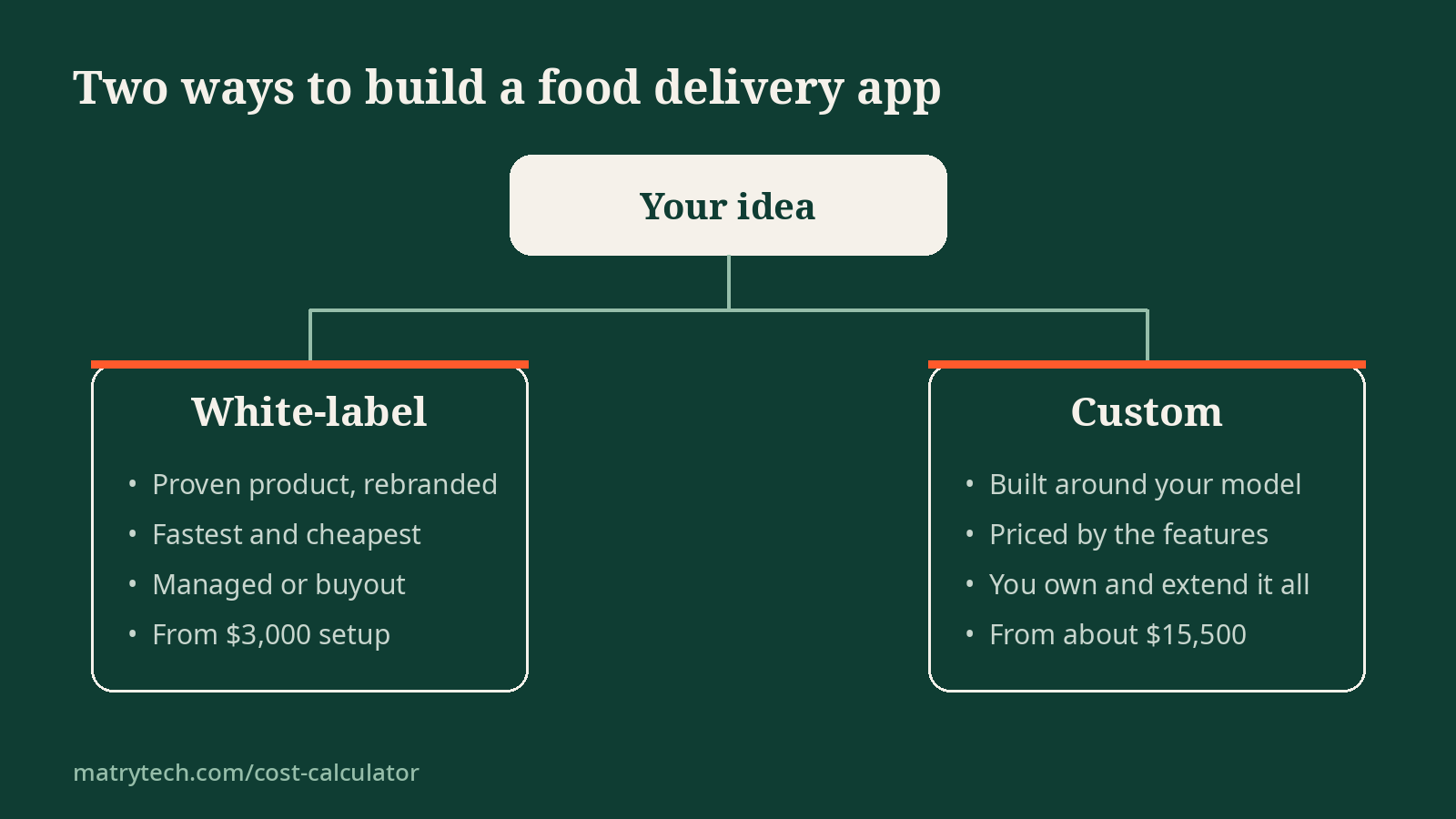
1. White-label: start on a proven product
We take a food delivery product that already works, rebrand it with your name, colours and city, and configure it for your market. This is the fastest and cheapest route.
You choose how to own it:
| Option | How it works | What it means |
|---|---|---|
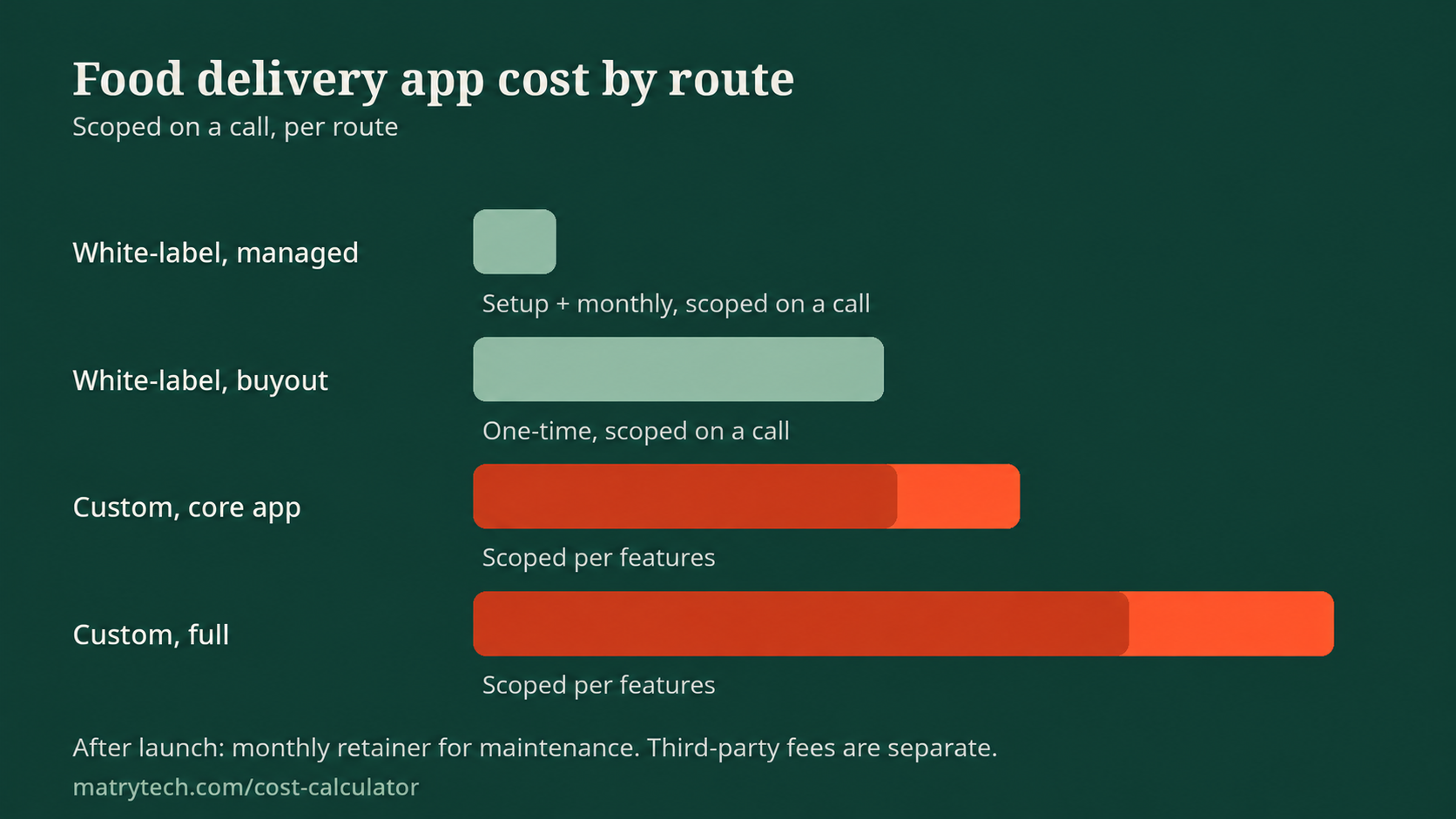
| Managed | Setup plus a monthly fee, scoped on a call | We host it, patch it and run it as your tech team. 12-month minimum term. Monthly fee steps up as your user count grows. |
| Buyout | One-time payment, scoped on a call | You get full source code and IP transfer, no recurring fee, and host it wherever you like. |
Over a long enough run, the buyout usually works out cheaper than managed. If you plan to run it for years, ask us to price both.
2. Custom: built around your model
A custom build starts from a blank repo and is priced by the features you pick.
- A core delivery app covers accounts, payments, maps and live tracking, and the admin panel.
- Add integrations such as restaurant POS systems, a web dashboard for restaurants, or a flagship-level design, and the scope grows with it.
The logic is the same as our cost calculator: a base price plus a cost for each feature, then a multiplier for design depth. Your number is scoped on a call.
After launch, plan on a monthly retainer for maintenance, hosting and support.
What a food delivery app actually contains
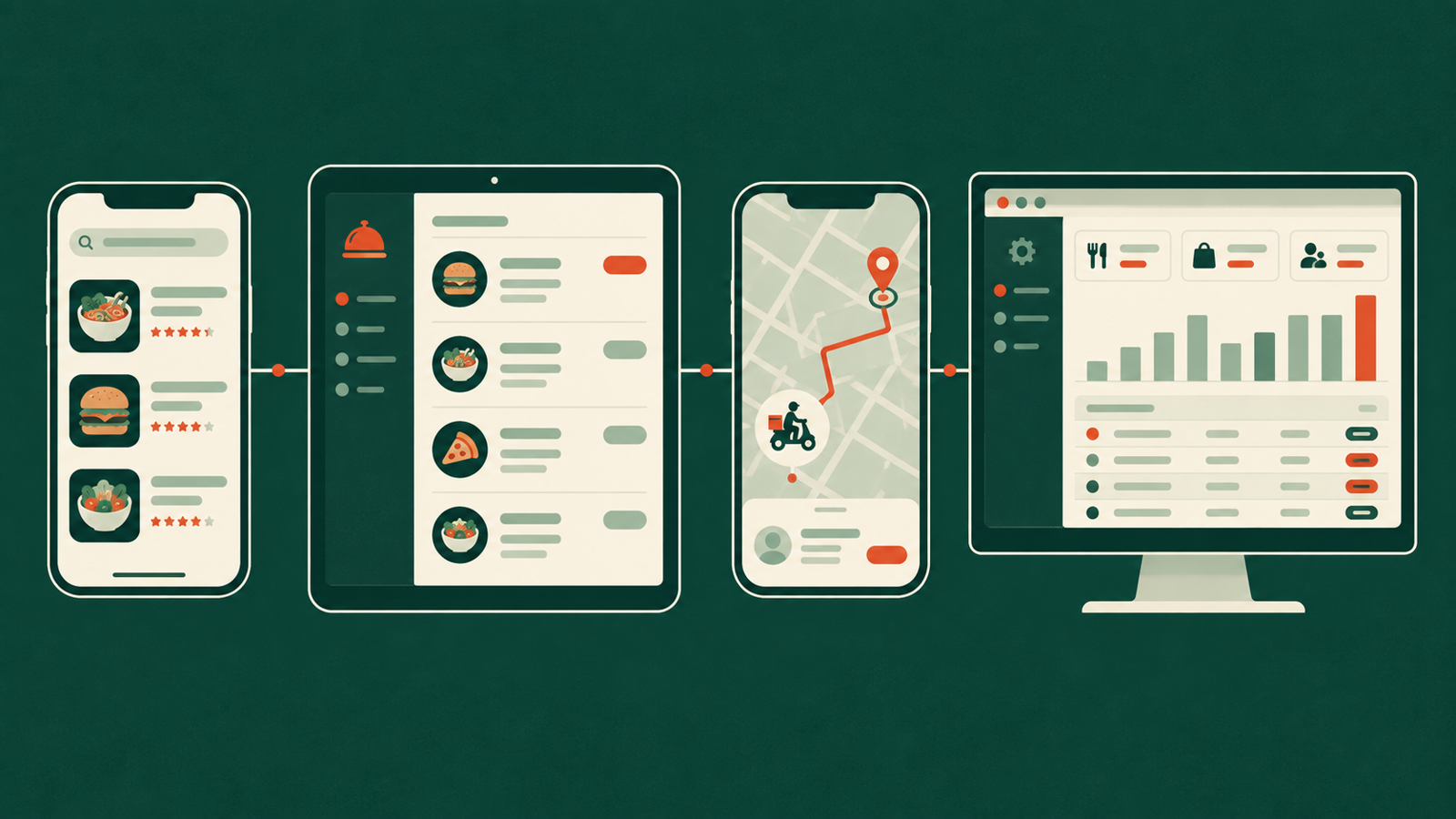
Three apps and one panel, not one app:
- Customer app: browse restaurants, cart, checkout, live order tracking, reviews.
- Restaurant app or dashboard: accept orders, manage menu and hours, payouts.
- Driver app: accept jobs, navigation, proof of delivery, earnings.
- Admin panel: commissions, zones, promos, disputes, reports.
What pushes the price up
- Custom design and branding instead of a rebranded product.
- Real-time logistics: live driver tracking, auto-assignment, batching.
- Payments: cards are simple. Wallets, cash on delivery and split payouts take more work.
- Multiple cities, currencies or languages.
- Integrations with restaurant POS and other systems.
- Loyalty, subscriptions and promo engines.
Costs outside our price
Third-party services are billed by their providers: maps and routing, SMS and push notifications, payment gateway fees, App Store and Google Play fees, and cloud hosting at higher volumes.
White-label or custom?
- White-label if you want to test a market quickly and your model is close to a standard marketplace.
- Custom if your model is different, like a niche cuisine marketplace, B2B catering or a dark-kitchen network, or if you need to own and extend every part of the system.
Fuel, grocery or courier instead of food? The same cost logic applies to any last-mile delivery model. Our fuel delivery app development page covers how we scope those builds.
We build custom apps first. Ready-made products are a shortcut when they fit, not a limit.
Get your own number
Try the cost calculator to see an indicative range for your features in a couple of minutes.
Want a firm scope? Book a 30-minute discovery call. We confirm pricing after discovery, not before. For custom builds and white-label buyouts, source code and IP transfer to you once development is complete and fully paid. Managed plans keep the code with Matrytech.