Flutter vs React Native for a Startup MVP in 2026
Flutter or React Native for your MVP in 2026? The honest answer: pick by your team, not benchmarks. Where each framework wins, what we run in production, and the four questions that decide it.
By Prakash Singh, Founder & CEO, Matrytech Solutions
Short answer: For most startup MVPs in 2026, both are good choices and neither will sink you. Pick Flutter if your app's look and feel is the product - consumer, design-heavy, custom UI. Pick React Native if your team already writes React or TypeScript, or you want the largest pool of JavaScript developers and libraries. The wrong way to choose is by benchmark charts. The right way is by your team, your hiring market, and what you will need in year two.
The 60-second version
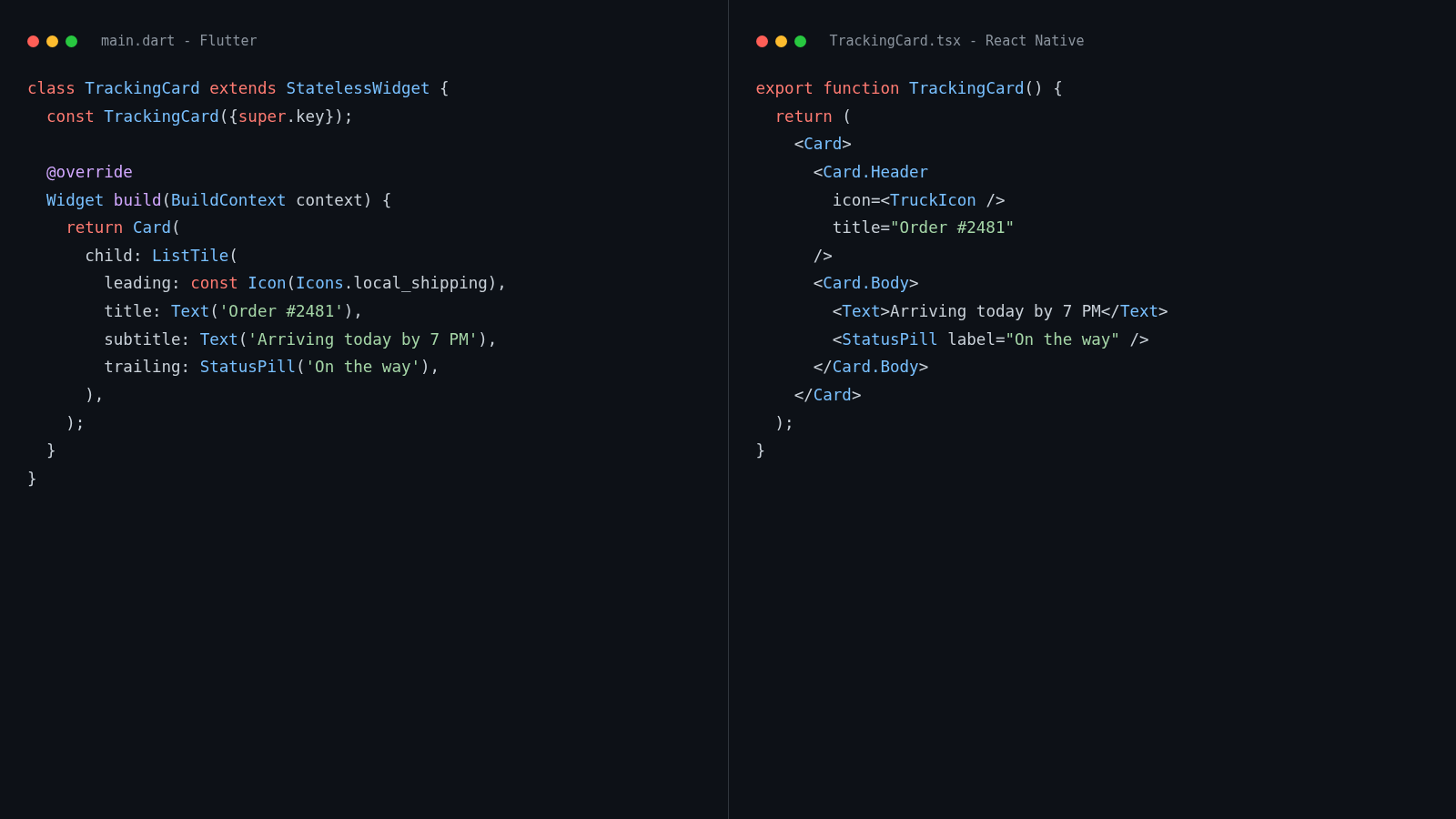
- Flutter: Google's toolkit. One Dart codebase with its own rendering engine, so the app looks and behaves the same on iOS and Android. UI quality and consistency are its strengths.
- React Native: Meta's framework. One JavaScript/TypeScript codebase driving real native components. Its strengths are the React ecosystem and developer supply.
- Both: fast iteration with hot reload, mature app-store support, and production track records at large scale.
Where Flutter wins
- Custom, animated, brand-heavy UI. Flutter draws every pixel itself, so a complex screen behaves the same on a budget Android and a new iPhone.
- Performance-sensitive screens. Smooth scrolling and animation under load, with no bridge between your code and the UI.
- Teams starting fresh. Dart is quick to pick up, and the tooling - one SDK, one inspector - is cohesive.
Where React Native wins
- Your team already knows React. Web developers become productive in days, not months, and you can share types and logic with a web dashboard.
- Hiring. JavaScript/TypeScript is the largest developer pool in the world. For a startup, hiring speed is a feature.
- Native modules. Payments, maps, notifications, analytics - if a service ships a mobile SDK, it usually ships a React Native wrapper early.
What we actually run
We build production apps in both. Our delivery platform's rider and customer apps are React Native, chosen because the team ships TypeScript end to end. Our newer consumer app is Flutter, chosen because its screens are the product. Both decisions were made on team and UI needs, not benchmarks, and both have held up in production. That is the honest summary of this whole debate: the framework matters less than matching it to the people who will maintain it.
How to choose for your MVP: four questions
- Who is building it? An existing React/TypeScript team points to React Native. A new or native-background team points to Flutter.
- Is the UI the differentiator? A custom design system with heavy animation points to Flutter. Standard app patterns: either works, lean React Native for ecosystem.
- What does year two look like? If you will also ship a web app, React Native lets you share types, validation, and sometimes components with the web codebase.
- Who will you hire next? Check your market. In India and most offshore markets both pools are deep; React/JavaScript is still the larger one.
What it costs and how long it takes
For a typical MVP scope - one core flow, auth, payments, admin - a focused team ships in 4-8 weeks in either framework. The framework does not move the budget much; unclear scope does. If a vendor quotes you very different prices for Flutter versus React Native on the same spec, ask what they are actually including.
Straight answers
Q: Is Flutter better than React Native in 2026?
A: Not categorically. Flutter leads on UI consistency and animation performance. React Native leads on ecosystem and hiring. For most MVPs, team fit decides.
Q: Can one developer build an MVP in Flutter or React Native?
A: Yes. Both are one-codebase frameworks, which is exactly why startups pick them. One strong developer can ship to both app stores from a single project.
Q: Will we have to rebuild when we scale?
A: No. Both run in production at very large scale. What forces rewrites is rushed architecture, not the framework.
Q: What about Kotlin Multiplatform or fully native?
A: Good tools, wrong stage for most MVPs. Native doubles your codebase, and KMP is maturing but has a smaller hiring pool. Revisit after product-market fit.
Q: Which do you recommend for a delivery or logistics app?
A: Either works - maps, live location and background updates are solid on both. We usually decide by the client's team: if they will inherit the code and know JavaScript, React Native; if we maintain it long-term and the UI is custom, Flutter.
Next step
Book a 30-minute discovery call: calendly.com/matrytech-info/30min
Bring your feature list - rough is fine - and tell us who will maintain the app after launch. We will tell you which framework we would pick for your case, and why, in writing.