Build an App Like Tab: The AI Assistant You Text, and What It Takes
Tab is a personal AI assistant you text on iMessage or WhatsApp, launched at a $300 million valuation. How it works under the hood, what it takes to build one, and where the opening is for smaller teams.

Short answer: Tab is a personal AI assistant that lives in your messages. You text it on iMessage or WhatsApp and it does the work: books, buys, calls, chases. Building the same kind of product means combining a messaging front end, an AI agent with its own browser and computer, phone-calling ability and a payment flow the user approves. What it costs depends on that scope, so we confirm pricing after a discovery call, not before.
What Tab is and why people are talking about it
Tab came out of stealth on October 7, 2026, at a $300 million valuation, backed by SV Angel, Valar Ventures and American Spirit, according to TechCrunch. The founders, Brennan Erbz, Stafford Schlitt and Ammar Amdani, started building it this year in San Francisco, and the company says it is growing mostly by word of mouth (TechCrunch).
The idea is simple. There is no app to download and no dashboard to learn. Tab has its own phone number, and you text it the way you would text someone capable: find and book a flight, call the hotel and move a reservation, turn a PDF into a spreadsheet, order a replacement part. You can send text, photos, screenshots, PDFs or video, and the answer comes back in the same thread.
How it works
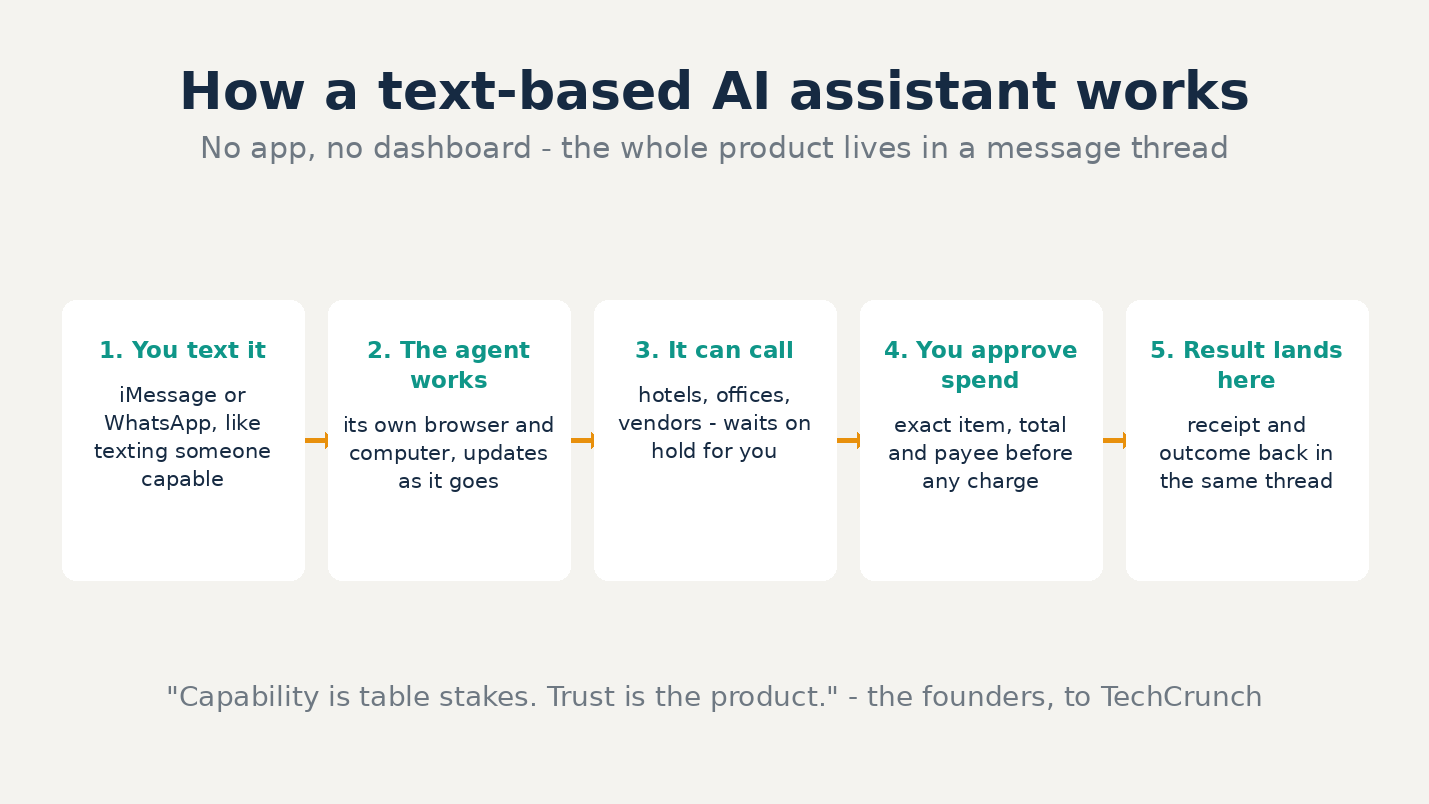
Alt: How a text-based AI assistant works, from message to finished job.
Under the chat thread, Tab is closer to a remote employee than a chatbot:
- The front door is messaging. iMessage and WhatsApp, channels people already open fifty times a day. No onboarding, no new interface.
- The agent has its own computer and browser. It opens websites, fills forms, makes files and works through the steps a job needs, sending short updates while it works.
- It can make phone calls. Calling a hotel, a doctor's office or a vendor, waiting on hold, asking the questions and reporting back.
- It can spend money, with your yes first. Before it pays, you see what it is buying, the total and who gets paid. Nothing is charged until you approve, and the receipt lands back in the thread.
- It remembers. You do not have to explain the whole story again tomorrow.
The founders are direct about the hard part: an assistant that can read email, make calls and buy things is only as good as the trust in it. Their rules: your data is never used to train AI, your card sits in a vault the company itself never sees, and nothing that cannot be undone happens without your approval. "Capability is table stakes. Trust is the product."
Why this design is winning
Muse showed the demand: Meta's personal agent passed 5 million downloads in three weeks. Tab takes the same job-to-be-done and removes the last bit of friction, the app itself. For a user, texting is the most natural interface there is. For a builder, the lesson is that distribution and trust now matter more than the model: several assistants can plan a trip, but the one people keep is the one that already sits in their messages and never surprises them with a charge.
What it takes to build a similar product
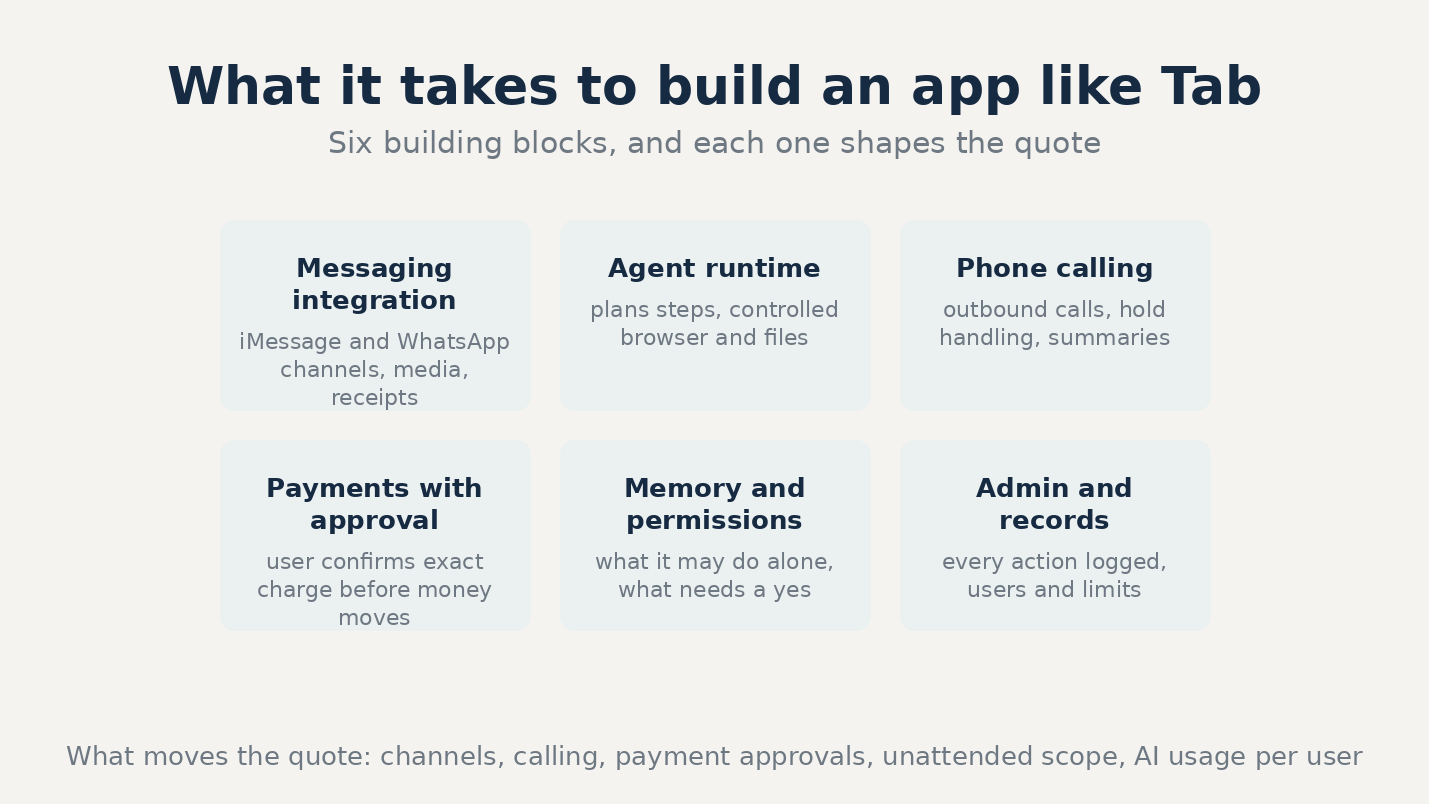
Alt: The building blocks of an app like Tab.
- Messaging integration: iMessage and WhatsApp business channels, media handling, delivery receipts.
- Agent runtime: an AI model that plans steps, plus a controlled browser and file system it can work in.
- Phone calling: outbound calling with speech, hold handling and call summaries.
- Payments with approval: a wallet flow where the user confirms the exact charge before money moves.
- Memory and permissions: what the agent may do alone, what needs a yes, and a record of every action.
What moves the quote
What moves the quote: how many channels you launch on, calling as well as chat, the payment approval flow, how much the agent may do unattended, and AI usage cost per user.
Costs outside the quote
- AI model usage, which grows with every user.
- Telephony and messaging fees for calls and texts.
- Payment gateway fees.
- Cloud hosting as users grow.
Should you build one?
Probably not a general assistant for everyone. Tab and Muse are spending heavily to own that ground. The opening for a smaller team is a vertical: an assistant for clinics, for logistics dispatchers, for property managers, for field staff. One job, one channel, done well, with the same trust rules Tab is betting on. That version needs fewer connectors, costs less and is far safer to launch.
We build custom apps first. Source code and IP transfer to you once development is complete and fully paid.
Wondering what it would cost?
Every agent product scopes differently, and the right start is often narrower than the full vision. Book a 30-minute discovery call and tell us the job you want an agent to do. You will leave with a firm scope and an honest quote, confirmed after discovery, not before.