Meta's Muse hit 10 million US downloads in 40 days. The launch numbers every app founder should study.
Only 12 apps in history have hit 10 million US downloads in 40 days. Meta's AI agent Muse just did it. The Sensor Tower numbers, the retention gap, and what they mean if you are building an agent app.
By Prakash Singh, Founder & CEO, Matrytech Solutions
Short answer: Meta's AI agent app Muse passed 10 million US downloads in its first 40 days, a milestone only 11 other apps have ever reached, per Sensor Tower data reported by TechCrunch. It is winning on Meta's distribution and ad spend, and it is keeping users better than the average rival AI app did at launch. If you want to build an AI agent app, the product bar is now approval-based agents connected to the apps people already use, and the hard part is retention, not the model.
What is Muse and how does it work?
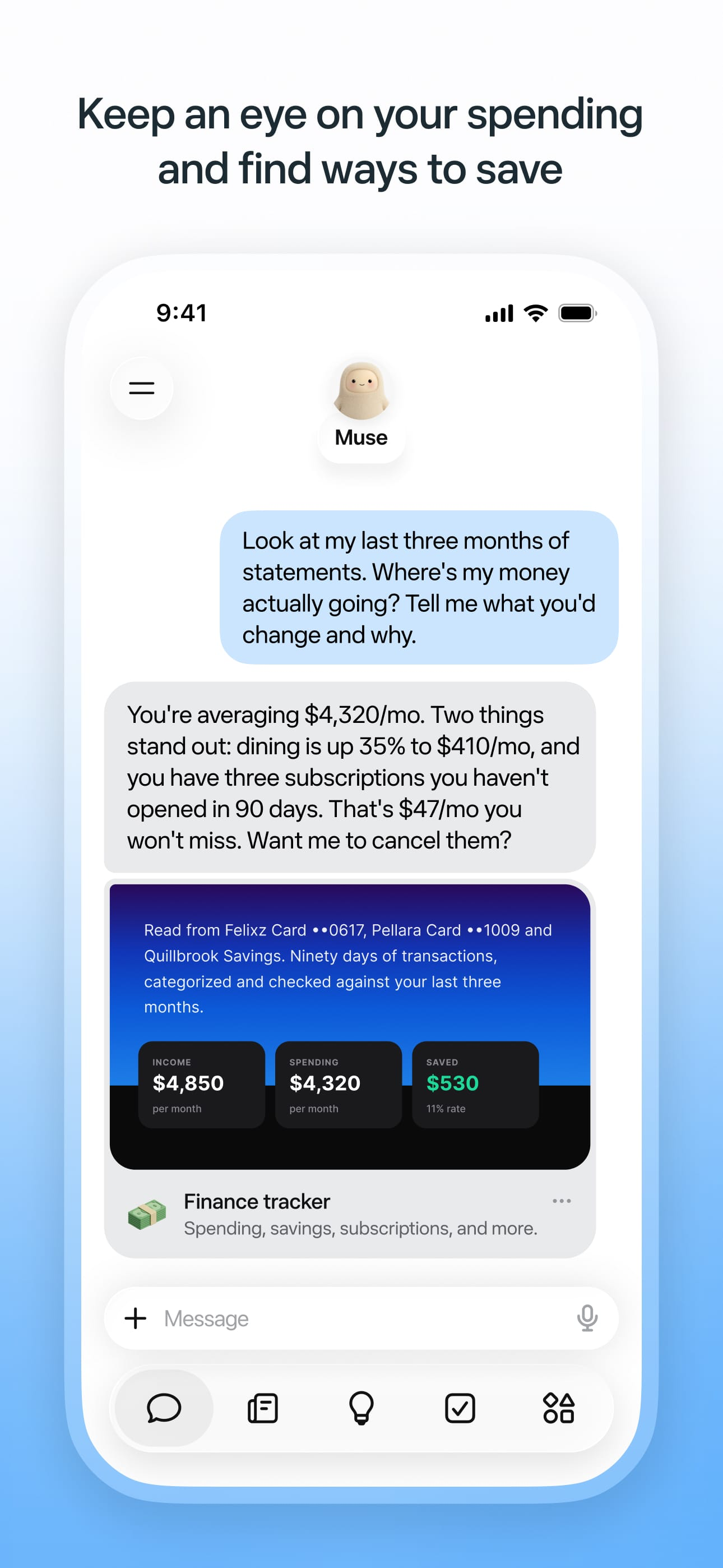
Muse is Meta's consumer AI agent, live in the US and Canada since September 2026. Meta's own App Store description calls it "your personal AI agent that gets things done": it manages email, books dinners, tracks budgets, finds deals, and follows up with people, with your approval before it acts.
The short version of the mechanics (full teardown in our earlier breakdown, linked below):
Connectors, not prompts. Per the listing, users can link Gmail, Google Calendar, Instagram, Facebook, finances (Plaid), health apps, and Meta Business Manager, so the agent reads real context instead of starting every chat blank.
Approval-based actions. Meta's copy says actions run "with your approval" - the agent proposes, the user approves, nothing executes without an OK.
Goals, not just chats. The listing pitches giving Muse a goal like "find new customers" and letting it work connected Instagram Business, Facebook Pages, and ad accounts toward it.
Always-on memory. Per the listing, it tracks birthdays, deadlines, price drops, and spending patterns across months, then acts on them unprompted.
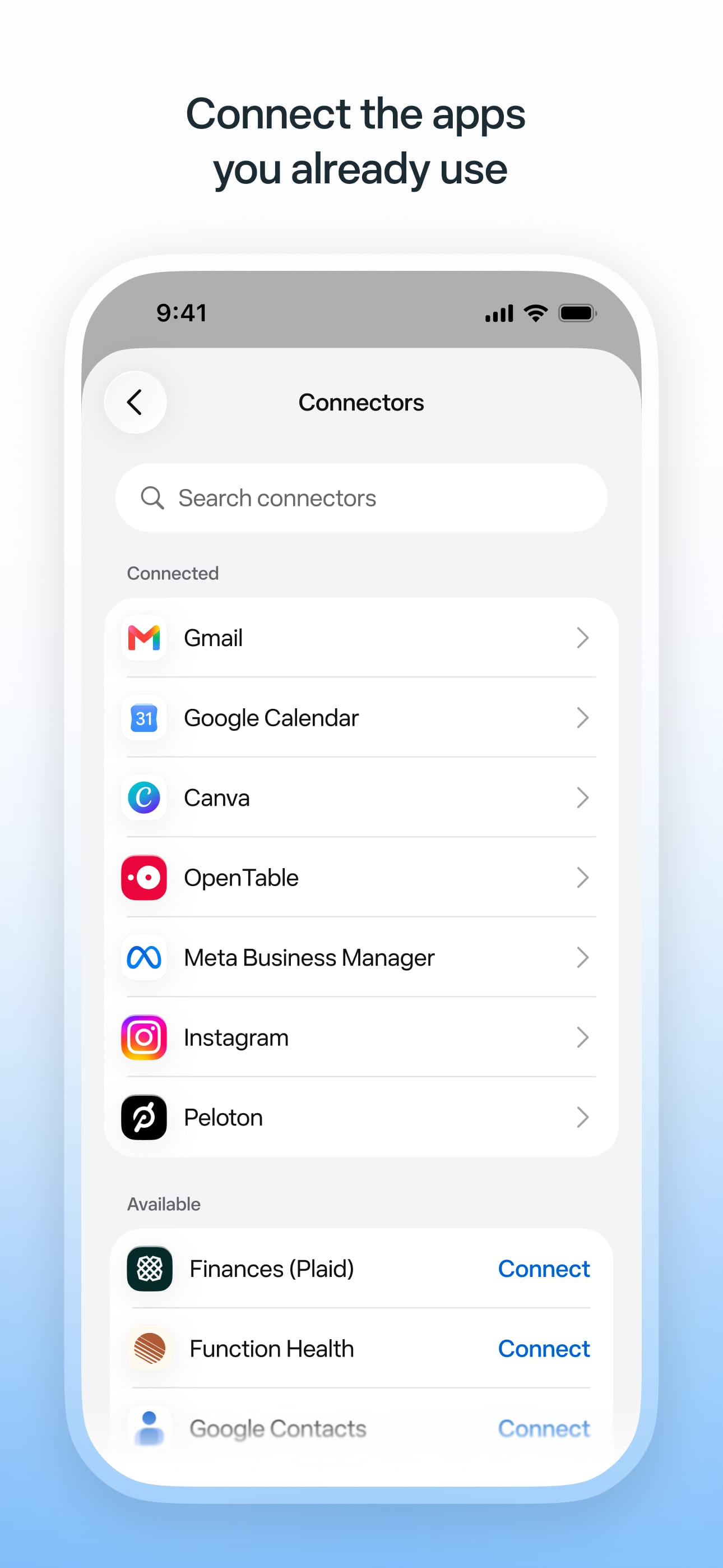
Muse’s connectors screen. Source: official App Store listing (Meta).
The numbers behind the launch
Sensor Tower data, reported by TechCrunch on October 20, 2026:
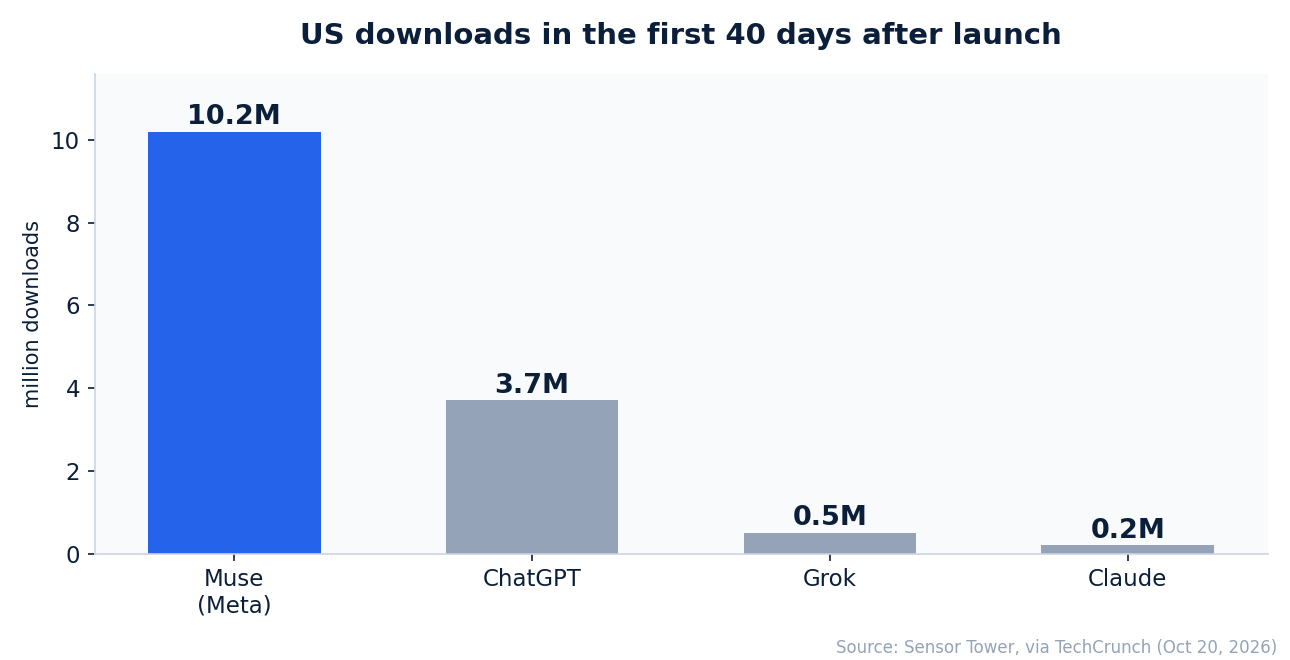
10.9 million downloads in 40 days, 10.2 million of them in the US. Only 11 other apps had ever reached 10 million US downloads in their first 40 days - Muse is the 12th. The last was Meta's own Threads in July 2023; most of the others were mobile games like Fortnite and Pokémon GO.
First-40-days US downloads, AI apps: Muse 10.2M, ChatGPT 3.7M, Grok 0.5M, Claude 0.2M. (Globally ChatGPT still leads with about 15M, helped by markets like Japan where Muse does not operate yet.)
Retention: 30% of US users still active after 7 days and 23% after 14 days, against a 19%/16% average for rival AI apps at launch (Sensor Tower's grouping).
Engagement: 2.5 million daily active users on October 16, up 15% week over week.
Distribution spend: Meta put 39% of its total advertising budget behind Muse in October, up from 23% in September. Muse is now the 21st largest brand in the US by ad impressions.
Muse has held No. 1 on the US App Store all but one day since launch, and No. 1 on Google Play for the past 30 days.
Why Muse is winning
Three reasons, and only one of them is the AI.
1. Distribution nobody else has. Meta reaches 3.6 billion daily users across its apps and is spending heavily to push Muse to them. You cannot copy this. Threads proved the same playbook in 2023.
2. The agent pattern fits what people actually want. Chat apps answered questions. Muse does errands: cancels the subscriptions you forgot, books the dinner, watches the price drop. And the retention gap (30% vs the 19% rival average at day 7) suggests an agent that does things retains better than one that only answers.
3. Approval UX is the trust play. Meta's listing stresses that every action needs an explicit OK. That design choice is what makes people willing to connect Gmail, their bank via Plaid, and their business ad accounts to a two-month-old app.
Building an agent app? Start with the pattern, not Meta's scale
We published a full build breakdown when Muse launched - architecture, connectors, approval flows, cost drivers: https://www.matrytech.com/insights/build-an-app-like-metas-muse-how-it-works-and-what-it-takes
This week's numbers add the commercial half of the answer. The realistic read: paid acquisition only works if retention holds, and Muse's 23% day-14 retention is the bar that makes its install economics work. Meta buys distribution with 3.6 billion daily users and a 39% share of its own ad budget. A startup cannot copy that. What it can copy is the product pattern: connect the user's real data, propose useful actions, execute only on approval.
The same pattern (connect data sources, propose, execute on approval) is what we build for operations teams in logistics and delivery: dispatch agents that watch orders, chase exceptions, and message customers with a human approving anything customer-facing. Consumer scale is Meta's game; vertical agent apps for specific industries are still wide open.
If you are scoping an AI agent app, consumer or vertical, we are happy to walk through what it would take for your case. No pitch decks, just a straight scoping call: https://calendly.com/matrytech-info/30min
Straight answers
Is Muse free?
Yes, the app is free on the US App Store and Google Play, US and Canada only for now.
Did Muse really beat ChatGPT's launch?
In US first-40-day downloads, yes: 10.2M vs 3.7M (Sensor Tower). Globally, no: ChatGPT reached about 15M worldwide in its first 40 days because it launched in more markets.
Can a startup compete with Meta here?
Not head-on in consumer. The opening is vertical agents: one industry, deep connectors, real workflows. Meta will not build a dispatch agent for a 40-truck courier fleet.
What is the single most copied feature worth copying?
The approval step. Agent proposes, human approves, action executes with an audit trail. It is what makes users trust an agent with real accounts
One caveat that landed this week: Meta has paused Muse's sharing feature
On October 20-21, Meta suspended Muse's conversation-sharing feature after security firm Claroc reported finding more than 6,800 shared Muse conversations through public DNS records - links nobody was sent, open to anyone (Ars Technica, The Verge, Oct 20-21). The exposed chats held real business material: a marketing company's revenue, a workplace calendar, a loan application. The download story and the privacy story are the same story - millions of people connected a consumer agent to their accounts within weeks, and the guardrails shipped after the growth. If your team uses consumer AI agents with work data, treat every share link as public. The safer pattern is agents that run inside your own accounts, with an approval step and an audit trail - which is exactly how we build them.
Sources: Sensor Tower data via TechCrunch (Oct 20, 2026); Meta's Muse App Store listing. Charts built by Matrytech Solutions from the cited figures. Earlier build breakdown: Matrytech Insights (Oct 12, 2026) Muse sharing suspension: Ars Technica and The Verge (Oct 20-21, 2026)..