Grok Voice 3.0 Is Out: How to Use It, Best Use Cases, and What It Means for Your Business
xAI's Grok Voice 3.0 ranks #1 on Artificial Analysis's Speech-to-Speech Index (86.9), answers in under a second, and costs $0.08 per minute. Starlink already runs 20,000 support calls a day on it - how to use it, best use cases, and what it means for your business.
By Prakash Singh, Founder & CEO, Matrytech Solutions
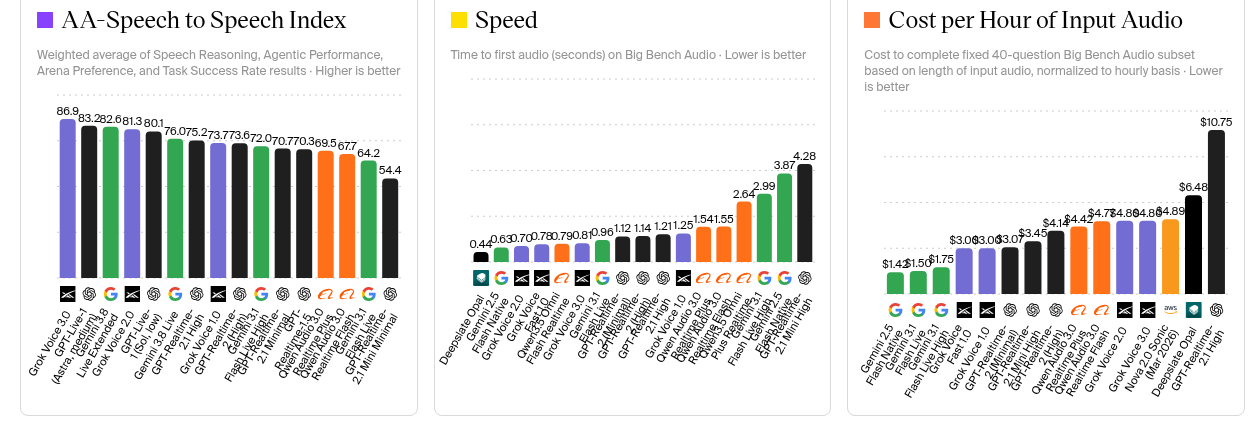
Short answer: xAI launched Grok Voice 3.0 on October 14, 2026 - a speech-to-speech model that now ranks #1 on Artificial Analysis's Speech-to-Speech Index (86.9), answers in under a second, and costs $0.08 per minute through the Voice Agent API. Starlink already runs 20,000 support calls a day on it, resolving about 70% with no human involved. If your business takes phone calls from customers, voice agents just crossed the line from demo to dependable - and this is the cheapest serious way to build one.
What is Grok Voice 3.0?
Grok Voice 3.0 is xAI's speech-to-speech model: you talk, it talks back, with no text layer in between. It powers millions of conversations a day across Tesla and SpaceX, and as of today it is available to everyone through the Voice Agent API at console.x.ai.
Three claims define the release. It is the top-ranked speech model on Artificial Analysis's independent Speech-to-Speech Index at 86.9, ahead of GPT-Live-1 (Astra) at 83.2 and Gemini 3.8 Live at 82.6. It handles pauses, turn-taking and interruptions almost like a person - 97% on Full Duplex Bench. And it answers in under one second, which is the difference between a voice agent that feels like a colleague and one that feels like an IVR menu.
The numbers that matter
Benchmark tables are usually marketing. Two rows here are worth your attention.
Speech reasoning (Big Bench Audio): 98.5%. The model does not just transcribe your words - it reasons about what you actually want. Task completion (Task Success Rate): 94.8%. It finishes the job the caller called about, not just the conversation.
The honest weak spot is accents and noise. On tau-Voice, which tests diverse accents, background noise and interruptions, Grok Voice 3.0 scores 71.6% - comparable to OpenAI's best, not ahead of it, though at 40% lower latency. If your customers call from trucks, warehouses and busy streets, that number matters more than the headline index.
What Starlink proves at scale
The most useful part of xAI's announcement is not a benchmark. It is a production deployment.
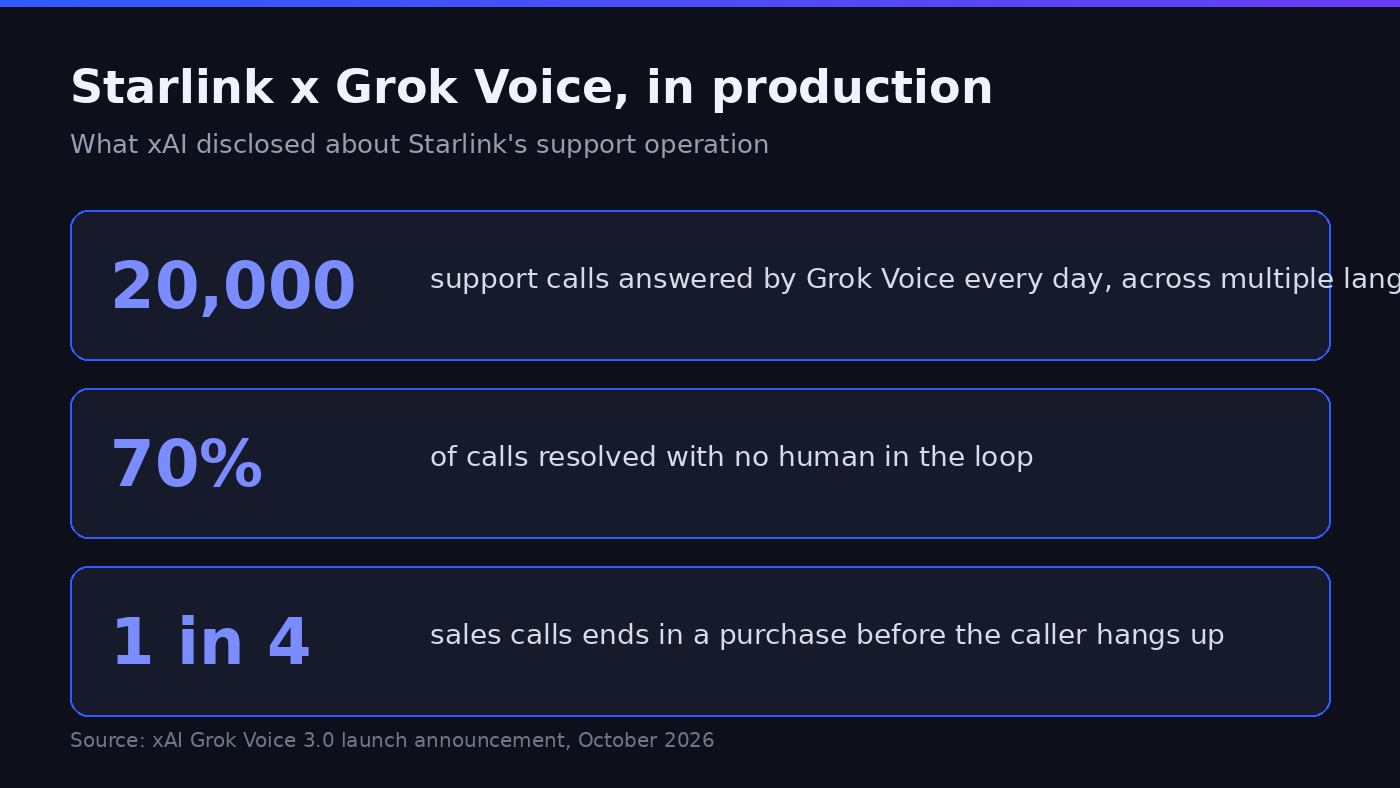
Starlink's call centers use Grok Voice to answer 20,000 customer calls every day across multiple languages. Roughly 70% are resolved with no human in the loop. One in four sales calls ends in a purchase before the caller hangs up. A single agent verifies the customer, troubleshoots hardware, issues credits and ships replacement equipment - the full workflow, not a triage bot that hands everything to a human anyway.
That is the template worth copying: one voice agent wired into your actual systems (orders, accounts, shipping, payments), allowed to take real actions, with a human escalation path for the 30% it cannot solve.
Free tool: run your own call volume through our Voice AI Agent Cost Calculator (Grok Voice 3.0 vs GPT-Live-1 vs Gemini 3.8 Live, with delivery presets).
How to use Grok Voice 3.0 today
Sign in at console.x.ai and open the Voice Agent API. There is a free tier to test with.
Pricing is $0.08 per minute ($4.80 per hour of conversation) - the same price as Grok Voice 2.0, and cheaper per resolved call than any staffed queue. For comparison, a 5-minute support call costs you $0.40 of model time.
If you already built on the API, agents using grok-voice-latest were switched to 3.0 automatically - no code changes needed.
The docs walk through connecting tools: your order system, CRM, ticketing and payment stack become function calls the agent can use mid-conversation.
Best use cases right now
Customer support lines with high-volume, repeatable questions. Order status, returns, appointment changes, account verification - anything where the answer lives in a system the agent can query.
Outbound calls that follow a script with real decision points. Delivery confirmations, payment reminders, rescheduling, feedback collection.
Multilingual support without hiring per language. Starlink runs calls across multiple languages on one agent - relevant if your customers span Hindi, English and Arabic.
After-hours coverage. A voice agent does not care that the call came at 2 AM.
What it means if you run a delivery or logistics business
Logistics is a phone-call business pretending to be an app business. "Where is my parcel" is still the most common support call in delivery, and most of those calls end with an agent reading tracking info off a screen the customer could not find.
A voice agent wired into your dispatch and tracking stack answers that call in under a second, in the caller's language, at any hour, for $0.40. The same pattern covers COD confirmation calls before dispatch, delivery-reschedule requests, and driver check-ins from the road - hands-free, which matters when the caller is driving.
The businesses that win the next five years of delivery will not be the ones with the most support agents. They will be the ones whose support scales with order volume instead of headcount.
Where voice agents still fall short
Be honest with yourself before you build. Accents and background noise are still the failure mode - test with your real call recordings, not demo audio. An agent that takes actions (refunds, reschedules, credits) needs hard limits and a clean human handoff, or it will cost you a customer instead of saving one. And a voice agent is only as good as the systems behind it: if your tracking data is stale, the agent reads stale data confidently, in a friendly voice.
Straight answers
What is Grok Voice 3.0? xAI's speech-to-speech voice model, released October 14, 2026, ranked #1 on Artificial Analysis's Speech-to-Speech Index with a score of 86.9.
How much does Grok Voice 3.0 cost? $0.08 per minute ($4.80 per hour) through the Voice Agent API - the same price as Grok Voice 2.0.
How do I try Grok Voice 3.0? Sign in at console.x.ai, open the Voice Agent API, and use the free tier. Existing agents on grok-voice-latest were upgraded automatically.
Is Grok Voice 3.0 good enough for real customer support? Starlink runs 20,000 support calls a day on it, resolving about 70% with no human involved - so yes, for high-volume repeatable calls with a human escalation path.
What is the main weakness of Grok Voice 3.0? Accents and background noise. It scores 71.6% on the tau-Voice benchmark, roughly level with OpenAI's best, so test it against your real call audio before deploying.
Voice is where AI agents stop being a demo and start being a P&L line. If you are thinking about what a voice agent looks like inside your delivery, courier or service business - what it connects to, what it is allowed to do, what it costs to run - that is exactly the build we do. Book a call